Article
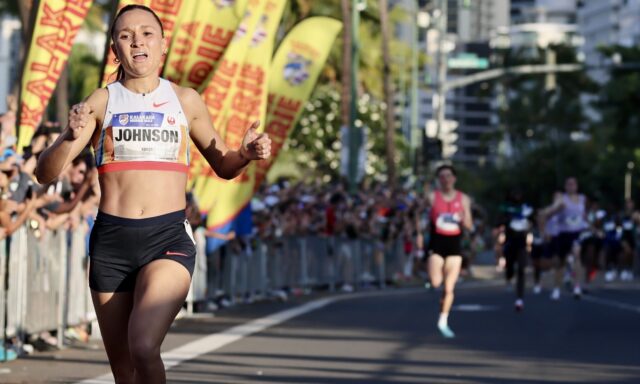
Johnson Wins Kalakaua Merrie Mile in American Record Time
(c) 2025 Race Results Weekly, all rights reserved. Published with permission.
HONOLULU (13-Dec) -– Sinclaire Johnson smashed the American record in the road mile to score a convincing win at the Kalakaua Merrie Mile on a warm and windy morning here in Waikiki. The race, held in conjunction with Sunday's JAL Honolulu Marathon, featured a unique mixed-sex pursuit format. The women's elite field was given a 31-second head start over the men, with prize money awarded based on overall order of finish. For the second year in a row a runner from the women's division took first place.
Johnson went out hard at the start, following pacemaker Aurora Rynda and quickly opening a gap of more than 10 meters on the women's pack. When Rynda stepped aside two minutes into the race, Johnson was essentially running a time trial to the finish. The flat out-and-back course on Kalakaua Avenue features a hairpin turn just past the halfway point, which gave her a chance to see how much of a lead she had built. "I was kinda shocked that nobody went with me," Johnson said. "It's really hard to tell in a road mile where you are. The turnaround is actually kind of nice because of that."
Meanwhile, the men's field, led by pacer Abe Alvarado, was slowly chipping into the 31-second gap. Too slowly, in fact, as it appeared Johnson's tactics --inspired by talk the previous day of an ambitious early pace for the men-- were paying off. When Alvarado dropped out at about three-quarters of a mile, Josh Hoey, this year's world indoor champion in the 800 meters, and Hobbs Kessler, the top men's finisher at last year's Merrie Mile, were leading the charge in a tightly bunched men's pack but running out of room to get the win.
Up ahead, Johnson ran unchallenged to the finish, clocking 4:21.66 to break the U.S. record of 4:23.98 set by Krissy Gear in April at the Grand Blue Mile in Des Moines. That time also moves her to No. 2 on the all-time world list for the road mile, behind Ethiopia's Diribe Welteji, who set the world record of 4:20.98 in 2023. It was also the fastest time ever on U.S. soil. "I was pleasantly surprised with what I ran," said Johnson, who also set the American record in the track mile this season, clocking 4:16.32 at the London Diamond League meet in July. "Part of my goal this year is really trying to be fearless in races. And there's no better place to practice that than in a low-key road mile. So today I was fearless and it paid off."
And it wasn't until she turned around after the finish line that she realized how convincing her victory was. "The last 200 the fans [lining the course] got really loud and I wasn't sure if someone was coming up on me or if they were just cheering for me," said Johnson, who is coached by her fiancé, Craig Nowak, in Portland, Oregon. "That last stretch I was trying to dig deep and give it everything I had."
Nikki Hiltz, who was the overall Merrie Mile winner last year (off a 32-second head start) and won their third straight USATF title in the 1500 meters this summer, emerged from the women's pack to grab second overall in 4:24.50. Hoey closed fastest among the men and took third place in 3:54.77, passing Kenya's Susan Ejore-Sanders (4:26.47) shortly before the line, followed by Kessler (3:56.21).
"This [pursuit] format makes it much more intense," said Hoey, who arrived in Hawaii on the heels of a world indoor best in the 600 meters (1:12.84) in Boston one week earlier. "I do mostly distance training, so the 600 was kind of a fun experiment and I was happy with how that went. But really I'm a miler, so I prefer this distance. I would definitely come back and do this race again."
For the overall win, Johnson earned $10,000 (an increase from last year's $7,500 top prize). Hiltz takes home a $5,000 check as the runner-up, while Hoey scored $3,000 for third, plus a $2,500 bonus as the top male finisher (because a woman was the overall winner). Ejore-Sanders ($1,500) and Kessler ($1,000) also won prize money.
Olympic bronze medalist Yared Nuguse (3:57.25), who was the overall Merrie Mile winner in 2022, finished third among the men, ahead of Kenya's Festus Lagat (3:57.80) and New Zealand's Geordie Beamish (3:58.17), this year's world champion in the steeplechase.
Weini Kelati (4:29.83), the runner-up here last year, took fourth among the women just one week after winning the U.S. cross country title over 10-K. Japan's Nozomi Tanaka (4:30.04) placed fifth.
Earlier in the morning, the citizens' race featured 2,854 finishers, up from 2,315 in 2024. Ka'eo Kruse, a Kalaheo, Hawaii, native who now lives in Boulder Colorado, was the men's winner, in 4:17.21. "Just being able to represent Hawaii and winning a home race felt great," said Kruse, who competed collegiately at Harvard and the University of Virginia and was an elite triathlete. "These guys are good, they were pushing it, so I just bided my time and waited for the right spot to make my move. I'm pretty confident in my kick."
Great Britain's Hollie Parker, who finished seventh in the 1500 at this year's U.K. championships, won the women's division in 4:46.25 after only deciding to hop into the race one day earlier. "Better than a Friday workout," she said with a laugh. "It felt like a sprint. On the road, a mile is really hard to feel so I was just sprinting the whole way."
PHOTO: Sinclaire Johnson winning the 2025 Kalakaua Merrie Mile in 4:21.66 setting a new American record (photo by Jane Monti for Race Results Weekly)

Sinclaire Johnson To Test Her Fitness At Kalakaua Merrie Mile
(c) 2025 Race Results Weekly, all rights reserved. Published with permission.
HONOLULU (12-Dec) -- Sinclaire Johnson's professional running career has often felt like a roller coaster ride. A pandemic, stints with two training groups and countless injuries stood in the way of consistency for the 2019 NCAA champion in the 1500 meters. Along the way there were highs (a 2022 USATF national title in the 1500) and lows (an agonizing fourth-place finish at the 2024 Olympic Trials) and frustration. That all changed over the past year, in which the Oklahoma State grad thrived under the coaching of her fiancé, stayed injury free, made her second World Athletics Championships team, and broke the American record in the mile.
Now the 27-year-old Florida native has returned to Honolulu to race Saturday in the Kalakaua Merrie Mile road race for the second year in a row. The Waikiki event, held in conjunction with the JAL Honolulu Marathon, features a unique mixed-sex pursuit format for the elite athletes, with the women's field getting a head start over the men.
Last year, for the first time since the event began in 2016, an athlete from the women's field took the crown. After a 32-second heat start, Nikki Hiltz crossed the line first, followed closely by Weini Kelati and Johnson, then Hobbs Kessler was the first man to finish, a fraction of a second behind. "This race last year was a lot of fun, I definitely wanted to put it in on my calendar again," Johnson told Race Results Weekly. "This is the end of the year, but it's kind of opening up the 2026 racing season."
At last year's Merrie Mile, Johnson was looking to get past the disappointment of her fourth-place showing at the Olympic Trials, when she missed a spot for the Paris Games by one place. But there was a silver lining: She recorded a lifetime best of 3:56.75, making her the sixth-fastest American 1500 runner of all-time. "That race is so interesting to look back on because I wouldn't have done anything differently," she says. "I PR'd by two seconds and I also ran a race that I was really proud of. I attacked it and went for it. It just didn't come together on the day." And it coincided with a major turning point in her career. "In a way it was a blessing disguise, which sounds weird because obviously I would have loved to make the Olympic team, but it really forced me to make changes that were necessary."
Chief among them was parting ways with coach Pete Julian and the Union Athletic Club and starting to train under the eyes of her fiancé, Craig Nowak, in Portland, Oregon. "We've been together for almost nine years at this point, and we met in college, so Craig has seen me through our college coach [Dave Smith], then Jerry Schumacher, who was my first pro coach [at Nike's Bowerman Track Club], and Pete Julian. He's had a first-hand look at how I've responded to certain training aspects. And he himself is a pretty good runner, too, so he understands the ins and outs of this niche sport."
Nowak won multiple Big 12 titles at Oklahoma State and then was a national-class steeplechaser for several years. Now essentially retired from pro racing, he guides Johnson's training and often joins her for some of her workouts. "I feel like focusing on health has been the number one change we've made," he says, a nod to the fact that two separate injuries in 2024 alone limited her racing. "And also focusing on where we are now instead of thinking so far in the future. Thinking about all the big things you want to do can sometimes make coaches act too aggressively in the now instead of seeing where you are and building from there."
The results of this new dimension to their relationship were immediate. Johnson remained healthy all year. She was the runner-up to Hiltz at the USATF Championships indoors and out, both times qualifying for the world championships. (She finished sixth indoors in Nanjing, China, and 13th outdoors in Tokyo.) In between she placed fourth in the mile at the London Diamond League, clocking 4:16.32 and slicing three hundredths of a second off Hiltz's U.S. record. "I knew it was going at a pretty aggressive pace and I felt like I should take advantage of that," Johnson says. "Doing it at the London Stadium in front of 60,000 fans, it's really hard to explain how cool that was. It was a very special race that I'll remember for the rest of my career."
On Saturday she'll complete her competitive year in Honolulu. "I really like the format of this race where the men are chasing the women. It feels very pure, like you're running away from the boys in elementary school again," she says with a laugh. "And it's also just a nice time of the year where it's fun to break up fall training and see where your fitness is. It's not a high-stakes race, it's really just for fun. We're going to go run hard, but we're here to enjoy and celebrate all we've done this year."
Plus, there's a hefty financial incentive to do well. The gap between the women's and men's starts will be down by one second from last year, to 31. Prize money is awarded based on overall order of finish to the top five ($10,000, $5000, $3000, $1500 and $1000) and the top finisher in the men's or women's category who is not the overall winner will receive a special bonus of $2500. There will also be a $10,000 bonus for a world record in the road mile (3:51.3 for the men and 4:20.98 for the women). "The caliber of the women's field is really strong and if we really push that first half and continue hard to the finish line then I think we have a really good shot at beating the guys," Johnson says.
Then it's on to 2026, during which Johnson hopes to make the U.S team for March's World Athletics Indoor Championships and compete for a medal, then earn a spot at the inaugural World Athletics Ultimate Championship in September (one week before her wedding). "It is an off-year, but there's still a lot of opportunity," she says. "I think the way that we look at it is that these are building blocks to L.A. 2028 [the next Summer Olympics]. I'm really looking forward to seeing how having this past year under my belt is going to help me progress throughout the year."
PHOTO: Sinclaire Johnson on the track at the 2025 World Athletics Championships in Tokyo in September (photo by Jane Monti for Race Results Weekly)
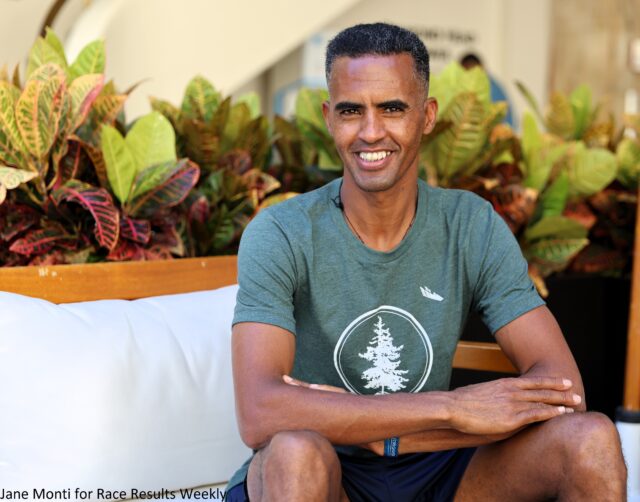
After Ninth Place Finish In NYC, Weldlibanos Hopes for Honolulu Marathon Win
(c) 2025 Race Results Weekly, all rights reserved. Published with permission.
HONOLULU (11-Dec) -- Just six weeks after a solid showing in the TCS New York City Marathon, Tsegay Weldlibanos is looking to pull off an ambitious double at the JAL Honolulu Marathon here on Sunday. The Eritrean-born athlete, who lives and trains in Flagstaff, Arizona, leads the race's deepest field in recent years. He'll face off against the defending champion --and his training partner-- Yemane Haileselassie as they pursue a $25,000 first-place prize (not to mention an exclusive solid gold winner's medal crafted by race partner SCG, a Japanese goldsmith, which is worth $27,000 at current gold prices.
In New York on November 2, Weldlibanos was running with the front pack through about 33 kilometers (21 miles), but couldn't match the leaders' breakaway. He rallied to finish ninth in 2:10:36, a credible performance on a demanding course.
"In general, I'm happy because I had very good preparation and I was ready for that race," he said in an interview here yesterday, with translation help from training partner Amanuel Mesel, who is also running on Sunday (after finishing fifth last year). "But unfortunately, in the last stages of the race I had to throw up and had to lag behind because of that."
But the decision to run in Honolulu was not part of a hastily arranged redemption mission. It was always the plan for the 29-year-old Weldlibanos to do this double. He is hoping to capitalize on the fitness he built this fall, and he hasn't missed a beat since crossing the finish line in Central Park. "He came off New York really strong and has managed himself well," said James McKirdy, who coaches Weldlibanos. "I actually think he's more fit now than he was for New York."
This will actually be Weldlibanos's second attempt at the Honolulu Marathon. He lined up in 2023, but after getting sick with COVID a week before the race he was unable to finish, dropping out at about 15-K. He finally had a chance to show his true potential over 26.2 miles at the 2024 California International Marathon, which he won in 2:07:35, setting a course record and breaking his previous personal best of 2:09:07 from 2019. That makes him the fastest entrant in this year's field. He also won the Hapalua Half Marathon in Honolulu this past April, so he's familiar with the humid conditions that come with racing in Hawaii. "The weather is going to be warm, but I'm really ready mentally for that," he said. "And it's going to be that way for everybody."
January will mark six years that Weldlibanos has lived in the United States. He sought asylum to escape the oppressive conditions in Eritrea, but it came with a steep price: He has been separated from his wife and daughter during that entire time. They are currently safe in Eritrea, and weekly phone calls help him stay in touch, but Weldlibanos admits it has been difficult. His path to U.S. citizenship has been slow, but he finally had a meeting with U.S. Citizenship and Immigration Services in June. The timetable going forward is ambiguous, so he's unsure when his case might advance.
While his life is filled with uncertainty, running has helped give him structure and a sense of purpose. "It's very hard to focus on training while I have all these things, but that's what I have to do," said Weldlibanos, who competes frequently in U.S. races. "First and foremost, as a professional it's in my blood, I love my career, so that motivates me to focus on the running. I have an opportunity to grow."
Over the past 15 years Weldlibanos has raced all over the world, and his resume includes championship experience. He finished 38th at the 2015 World Athletics Cross Country Championships, helping Eritrea to a fourth-place finish. He also took seventh in the 5000 meters at the 2014 World U20 Championships.
But unfortunately, without a national team affiliation right now he has been unable to attract sponsorship from shoe companies, which prioritize athletes who can compete at the Olympics and world championships. He supplements his racing prize money income with a job as a ride-share driver in Flagstaff. He works about 25-30 hours a week, on top of putting in about 110 miles or running.
It helps that he has the camaraderie of the McKirdy Training group, a diverse mix of international athletes (some of whom are also in the U.S. under asylum). "It's a blessing to be with such a group. We have known each other for a long time, some of us from back home, and we have a very strong team," Weldlibanos said. "James is always with us, giving us everything we need. Having these teammates to work with is very special."
With several of his teammates joining him in Honolulu, "it's going to feel like a training session," he said. Not that it won't be competitive. "For our team, we didn't come here to jog, we came here to destroy the competition and honor the race with our efforts," said McKirdy, who believes that Weldlibanos is in shape to break 2:10 on Sunday. That would be an exceptional time for a race known for its hilly terrain and warm and humid conditions. The course record is 2:08:00 (2:07:59.02) by Kenyan Titus Ekiru in 2019.
Weldlibanos knows that it will be a challenge, but his confidence is high. "I'm ready. I've done the work," he said. "I am not going to assume that I will win the race, but I assure you that I going to do my best in the race."
PHOTO: Tsegay Weldlibanos at a Waikiki hotel in advance of the 2025 JAL Honolulu Marathon (photo by Jane Monti for Race Results Weekly)

From Landfill to Legacy: The Shift Every Race Needs
“Cups on the road”
When I am asked what I do for work, I tell them that I work at the intersection of sustainability and running.
The response is almost always, “oh, like cups on the road”.
For runners, seeing hundreds...even millions, of cups crushed underfoot is one of the rare times we’re forced to confront our own consumerism directly.
For race organizers, there is a weight that sits on their shoulders.
They know that their event has to prioritize safety, performance, the runners having a good day, over the health of our planet.
But they see the impact their event has, and know they want to do better. Know that they want to leave a legacy of something positive in this world, and watching huge volumes of waste leave their race area is not necessarily in alignment with that.
The Challenge of Measuring Impact
Measuring your environmental impact is no easy task, and is one of the biggest barriers for many race directors to begin their environmental journey.
It is one of the reasons we created Racing For Sustainability, to give race organizers a place to start, the resources to make it easy, the guides to pass along to volunteers.
Taking steps toward sustainability can feel indulgent, it’s easy to postpone (I get it!), but it’s actually future-proofing your event to grow, evolve, and improve year upon year. We all know there are events that have appeared on the scene like a viral video flourishing, only to fizzle away soon after.
I know race organizers want to create something that lasts, and considering sustainability is not only going to lift the guilt that sits on your heart, but matters more than you think.
A New Era of Opportunity
With races continuing to see a running boom, the World Abbott Marathon Majors continuing to push the boundary of what is possible for a max number of runners.
Many other races selling out in record time, runners are selecting events where people they admire go and races that align with their love for community.
Gen-z participation has been discussed at length, with the 2025 Running USA Global Runner Survey confirming what other, more general research has concluded, that Gen Z runners are more likely to seek out and/or choose to enter events that support social justice initiatives, which fall under the larger umbrella of sustainability.
If your community feels welcomed, seen, and respected, your race is more sustainable for the long term.
Sustainability is not just about environmental choices. If you lose community support, your race could quickly become an event of the past. Event reputation matters to runners, especially Gen Z.
Practical Steps to Future-Proof Your Race
So what can be done to future proof your event?
You don’t need to do all of these, but selecting one of these intentional, conscious sustainable actions to start with can be a talking point for runners to share about your event, and will stand out enough to have your runners want to come back over and over:
- Work with Badges and Medals on your medals. From 100% recycled zinc alloy medals with 100% recycled plastic ribbons, to their work with Plastic Bank and One Tree Planted, Badges and Medals is putting in the work to become the leader in sustainable medals. Their obsession with quality medals that stand out will beautifully match the heart of your event
- Sorting your waste. Not glamorous, not a talking point runners will jump to, but in terms of most effective reduction of emissions, waste diversion away from landfill is the clear winner. Recycling and compost are bare minimums, but this can be expanded to include heat sheets and working with terracycle to recycle nutrition and gel wrappers. Racing For Sustainability members have a guide on how to do this, as well as printable signage to put above your bins.
- Hemp Bibs. I had the privilege of running in the first race in the US to use these (RunVirt did an amazing job), and they worked even better than I expected. My custom made test hemp bib has now run two marathons and looks brand new. This is the future.
- Find your sustainability champion. This one requires a little work if you do not have someone in mind. Sustainability works best when you have someone local who is a passionate leader, able to mobilize your volunteers to do the work on race day. If you can’t fund someone in your area, send me a message, I may be able to help you through our network of climate passionate runners
- Compostable cups. A slight increase in cost, but worth it with how good it feels to see truckloads of compostable cups broken down into soil, over taking up space in a landfill. See if a local sponsor is interested in covering the additional cost and adding their logo to the cups.
Easy places to start, but simply doing one of these, then talking about it through your website or on your social media, can have a big impact.
Every race tells a story. Of effort, community, and care. The question is, what story will your event leave behind?
About the Author: Tina Muir
Tina Muir is a climate advocate, former elite marathoner, and founder of Racing for Sustainability, a nonprofit dedicated to driving environmental and social responsibility in the running industry. Through her leadership, Tina works with races (TCS NYC Marathon, Bank of America Chicago Marathon, TCS Toronto Marathon, California International Marathon and more), brands, and communities to implement sustainable practices that reduce impact and promote equity in sport.
She is also the CEO of Running For Real, a platform that empowers runners to engage with climate action, mental health, and inclusion. As host of the award-winning Running For Real Podcast (6M+ downloads), Tina brings environmental issues to the forefront through meaningful conversations with athletes, scientists, and changemakers.
A co-author of Becoming a Sustainable Runner and a United Nations collaborator, Tina is recognized globally for helping runners become advocates for a healthier planet. Her work exemplifies how sport can be a powerful tool for environmental and cultural change.

Belayneh Repeats As Boston Half-Marathon Champion
(c) 2025 Race Results Weekly, all rights reserved. Published with permission.
BOSTON (09-Nov) -- Ethiopia's Fantaye Belayneh repeated as the Boston Half-Marathon women's champion this morning, running a patient race and ultimately winning with a powerful sprint for the tape. The 25 year-old, who represents adidas, clocked 1:08:51, just two seconds ahead of compatriot Melknat Wudu. She recorded the fourth-fastest winning time on the hilly and winding course which takes in some of the Boston area's most beautiful parklands and residential neighborhoods. She won $15,000 in prize money.
"I'm so happy, and I'm thrilled I won back-to-back," a smiling Belayneh told Race Results Weekly through a translator.
Belayneh was content to stay tucked in the lead pack for most of the race. Evaline Chirchir of Kenya and Megan Sailor of nearby Dorchester set the early pace. The first five kilometers, which featured plenty of hills, was covered in 16:23. Chirchir, Sailor, Wudu, and Kenyans Mercy Chelangat, Grace Loibach, and Monicah Ngige were part of a lead pack of ten women. Three other Americans --Molly Born, Keira D'Amato, and Everlyn Kemboi-- were part of the lead group.
Sailor led through the fourth mile, which passed in a swift 5:11. The pace was getting a little hot for D'Amato, who is training for the Valencia Marathon on December 7. The 41 year-old decided to drift back.
"Disconnecting from the group, I felt like I didn't have another option, unfortunately," D'Amato told Race Results Weekly. "Going through the hills and the wind, alone, that was a battle in itself."
The first real move happened in the sixth mile where Chirchir, Belayneh and Wudu picked up the pace. Running single file, the three ran a 5:02 split for the sixth mile, and crossed the 10K mark in 32:27. That whittled the lead group down to six: Chirchir, Wudu, Belayneh, Chelangat, Loibach, and Ngige. Kemboi was close behind, but losing contact, and Sailor was 11 seconds back. D'Amato and Born were running in ninth and tenth place, respectively.
The pace slowed in the ninth mile to a pedestrian 5:30. That was the signal for Belayneh to make her another move. She scooted to the front, and tried to open a gap. Wudu followed closely at first, but then drifted back. Despite running 5:02 for the tenth mile, Belayneh's move didn't stick. Loibach was the only one who was dropped (she would eventually finish seventh in 1:10:00).
"The move I made, I wanted to move out and lead to the finish," Belayneh said later. "That's the reason I decided to move on."
But with five women left in contention and five kilometers still to go, Belayneh decided she'd wait for the final meters to decide the race. The pack skinnied down to four by the 20-K point (1:05:33): Belayneh, Wudu, Chirchir, and Ngige. Belayneh liked her chances.
"I trained very well," she said. "I knew I could be the winner."
The final kilometer is capped by a challenging uphill, and using her knowledge of the course she waited for the short, flat section right before the finish line in Franklin Park. She stepped on the gas, and only Wudu was able to stay close.
"It turned out to be good," Belayneh said of her final sprint. "Then God helped me, and I won."
Chirchir, who had done most of the leading today, took third in 1:09:01. Ngige got fourth in 1:09:07, and Chelangat took fifth in 1:09:09. Behind the action at the front, Sailor --who was doing a great job of running the tangents-- got past Loibach before the 20K point to finish sixth in a personal best 1:09:39. She runs for the Boston Athletic Association's High Performance Team coached by Irish Olympian Mark Carroll.
"My goal coming in was just to commit," Sailor told Race Results Weekly. "I think I did a great job of committing the first five miles, and then they dropped it down and it was a little bit aggressive for me at that point. I knew as long as I just held strong throughout I would come home strong."
Born finished eighth in her half-marathon debut (1:10:11), Kemboi took ninth (1:10:18), and D'Amato rounded out the top-10 in 1:11:18, a time which would have won here on eight previous occasions. D'Amato was upbeat about her race.
"That was a good grind, a really good grind," said D'Amato. "I felt like I ran within myself, and strong. The hills got me a little bit, and my glutes locked up a little bit. But, it's good. It's everything you're going to feel in the marathon."
The men's race broke up more quickly. By the 10K point (28:49), only four athletes remained in the lead group: Kenyans Isaia Lasoi and Andrea Kiptoo, American Chandler Gibbens, and Eritrean Yemane Haileselassie, the race's defending champion. Santiago Catrofe of Uruguay was back in fifth place, about six seconds behind.
Lasoi --who came into today's race with the fastest personal best of 58:10-- pushed the pace through 10 miles (46:14), and only Kiptoo remained with him. Haileselassie was down by 12 seconds, and Gibbens was back about 21 seconds. Catrofe had passed Gibbens and was running in fourth place. By the 20-K mark (57:53) Lasoi had opened a 25-second gap on Kiptoo, and none of his rivals were going to catch him today. He clocked 1:00:59, the third-fastest winning time at this event. Like Belayneh he won $15,000 in prize money.
"This is my first time (in Boston)," said Lasoi. "From 17-K to the finishing it was a tough course. Hilly."
Lasoi had hoped to run faster.
"My aim was to break the course record," said the adidas-sponsored athlete. "When I see (the time) at 15-K I decided to go for the win. I tried to push it."
Catrofe had an excellent second half, moving up from sixth at 10K to second at the finish. He was still in third place at the 20K mark, but passed Kiptoo in the final kilometer and clocked a personal best 1:01:23. Kiptoo, who made his debut at the distance, took third in 1:01:30, and Haileselassie finished fourth in 1:01:45, one second faster than his winning time one year ago.
Gibbens, who is preparing for the USATF Cross Country Championships on December 6 in Portland, Ore., had a solid second half. He ran a personal best 1:01:57 to take fifth place. He ran the mostly downhill first 10K in 28:49, and the mostly uphill second 10K in 29:52.
"You could feel the hills," said Gibbens, who represents Saucony. "I mean for me, it was feeling good until it didn't, and then it was just getting through the rest of the race, just the same as cross country and sticking your nose in it."
The professional wheelchair champions were Americans Yen Hoang on the women's side (1:01:02), and Miguel Vergara on the men's (49:06). Both athletes won by comfortable margins (Vergara won by five and a half minutes), and each earned $5000 in prize money.
Today's race had just over 7000 finishers, up from about 6500 last year. It was the third and last event of the 2025 Boston Athletic Association's Distance Medley which began with the Boston 5-K last April, and continued with the Boston 10K last June. Next year's series begins on Saturday, April 18 with the Boston 5K, two days before the Boston Marathon.
PHOTO: Ethiopia's Fantaye Belayneh winning the Boston Half-Marathon for the second time in 1:08:51 (photo by Jane Monti for Race Results Weekly)