Event Operator
Kipruto Hopes To Get Back On Top At Boston Marathon
(c) 2026 Race Results Weekly, all rights reserved. Published with permission.
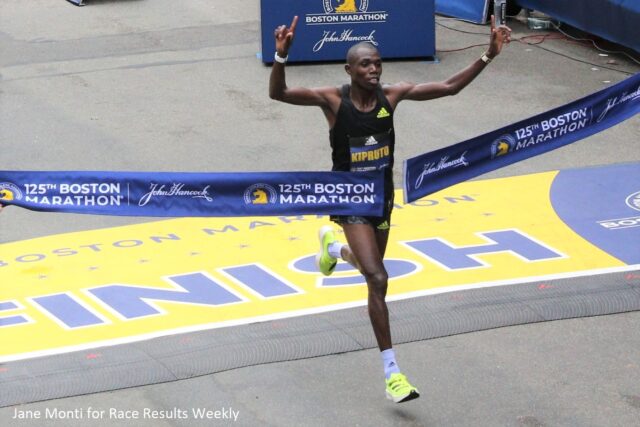
(21-Jan) -- Benson Kipruto, the 2024 Paris Olympic bronze medalist in the marathon, is --by at least one measure-- the most successful marathoner on American soil. The 34 year-old Kenyan, who represents adidas, is the only man in history to have won all three American races of the Abbott World Marathon Majors AND and an Olympic Marathon medal. He won the Boston Marathon in 2021, the Bank of America Chicago Marathon in 2022, and the TCS New York City Marathon in 2025. Uniquely, he's the only man to win the Boston Marathon in the month of October (the 2021 race was delayed from April until the fall due to the COVID-19 pandemic).
The Boston Marathon, which will be held for the 130th time on Monday, April 20, has always had a special meaning for Kenyan athletes, especially Kipruto. He's run the race four times. He only finished tenth in his first appearance in 2019, then won in 2021 after reeling in a solo breakaway by American C.J. Albertson who, at 25-K, enjoyed a one minute and 41-second margin. Kipruto caught him in the 21st mile.
"I didn't know that somebody was ahead," Kipruto later admitted to reporters, looking a little embarrassed.
He came back in 2022 and took third behind his training partner Evans Chebet and another Kenyan, Lawrence Cherono, who was later banned for seven years for doping. In 2023 he took third for the second time, beaten again by Chebet and also Tanzania's Gabriel Geay. He hasn't raced Boston since then, and is excited to come back this year. He ran the Tokyo Marathon, held in early March, the last two years, instead.
"Boston holds a special place in my heart," Kipruto said through a statement provided by the Boston Athletic Association (B.A.A.), the race founders and organizers. "I won my first Major there in 2021 and have finished third twice. I look forward to starting my 2026 season and racing a fast group of men in April."
Kipruto's last comment was not hyperbole. Even in the era of super shoes and inflated times, this year's Boston men's field is exceptionally fast. Twenty-five men in the elite field have run sub-2:07 during their careers (ten of them have run sub-2:05), and Kipruto's fastest challenger, compatriot John Korir, is the race's defending champion who, after dropping out of the Chicago Marathon last October, rallied to win the Valencia Marathon last month in a personal best 2:02:24. That was the #3 performance for 2025.
"I think I have closed out my year with a personal best and I say, 'thank you to God' and all those people who have been behind it," Korir told Pulse Sports in Kenya last month.
Among Kipruto's other key challengers are reigning world marathon champion Alphonce Simbu of Tanzania, who finished second to Korir at Boston last year then won the world title in Tokyo last September in a sprint finish by just 3/100ths of a second. He was also the bronze medalist at the 2017 World Championships in London.
"I made history today: the first Tanzanian gold medal at a world championships," Simbu said after his win in Tokyo. "I remember in 2017, at the World Championships in London, I won bronze. Then I ran many times but never got any medals, so finally it is here."
In all, the B.A.A. managed to lure back eight of the race's top-10 men from last year. Among them are Kenya's CyBrian Kotut (3rd in 2025), Utah's Conner Mantz (4th) and Clayton Young (7th), Canada's Rory Linkletter (6th), and Lesotho's Tebello Ramakongoana (8th). Mantz broke Khalid Khannouchi's 23-year-old national marathon record at Chicago last October and will be running Boston for the third time.
"Finishing fourth a year ago was very close to my goal of placing in the top three," Mantz said last month through a statement. "I'm eager to return to Boston and race against the best of the best again. Boston's full of history and I'm working to give it my all every step towards Boylston Street."
Other top men entered include Dutchman Abdi Nageeye, the 2021 Olympic Marathon silver medalist and the 2024 New York City Marathon champion; Ethiopian Lemi Berhanu, the 2016 Boston Marathon champion; Oregon's Galen Rupp, a two-time Olympic Medalist who will turn 40 in May; and Colorado's Zouhair Talbi, who just won the Chevron Houston Marathon in a personal best and course record 2:05:45. Talbi, who ran for Morocco in the 2024 Olympics will be eligible to represent the United States at the Los Angeles 2028 Olympics.
In the elite wheelchair division, all eyes will be on Switzerland's Marcel Hug, the world's most dominant wheelchair racer. Hug, who turned 40 last week, won Boston for the eighth time last April. His margin of victory over second place Daniel Romanchuk was more than five minutes. Hug's victory last year came on the 50th anniversary of American Bob Hall becoming the race's first wheelchair finisher. Hall attended the 2025 race as a special guest.
"One of my first racing chairs was a Hall chair," said Hug. "He opened the door for us to be able to participate here."
The race winners in the professional men's and women's divisions will earn $150,000 in prize money, the highest first place prize among the seven Abbott World Marathon Majors events. The professional wheelchair champions will earn $50,000, and setting a course record in either division is worth another $50,000.
The complete elite men's field for the 2026 Boston Marathon is below with personal best times:
PROFESSIONAL MEN'S DIVISION -
Benson Kipruto, KEN, 2:02:16 (Tokyo, 2024)
John Korir, KEN, 2:02:44 (Chicago, 2024)
CyBrian Kotut, KEN, 2:03:22 (Berlin 2024)
Abdi Nageeye, NED, 2:04:20 (London, 2025)
Lemi Berhanu, ETH, 2:04:33 (Dubai, 2016)
Hailemaryam Kiros, ETH, 2:04:35 (Sydney, 2025) CR
Alex Masai, KEN, 2:04:37 (Chicago, 2025)
Alphonce Felix Simbu, TAN, 2:04:38 (Valencia, 2024)
Mohamed Esa, ETH, 2:04:39 (Chicago, 2024)
Conner Mantz, USA, 2:04:43 (Chicago, 2025) NR
Yohanes Chiappinelli, ITA, 2:05:24 (Valencia, 2024) NR
Benard Biwott, KEN, 2:05:25 (Paris, 2025)
Kennedy Kimutai, KEN, 2:05:27 (Rotterdam, 2025)
Zouhair Talbi, MAR/USA, 2:05:45 (Houston, 2026)
Richard Ringer, GER, 2:05:46 (Valencia, 2024)
Sondre Moen, NOR, 2:05:48 (Fukuoka, 2017) NR
Galen Rupp, USA, 2:06:07 (Prague, 2018)
Akira Akasaki, JPN, 2:06:15 (Berlin, 2025)
Tebello Ramakongoana, LES, 2:06:18 (Xiamen) NR
Andy Buchanan, AUS, 2:06:22 (Valencia, 2024) AR/NR
Gemechu Dida, ETH, 2:06:45 (Valencia, 2025)
Hendrik Pfeiffer, GER, 2:06:45 (Valencia, 2025)
Rory Linkletter, CAN, 2:06:49 (Chicago, 2025)
Biya Simbassa, USA, 2:06:53 (Valencia, 2024)
Clayton Young, USA, 2:07:04 (Boston, 2025)
Tsegay Weldlibanos, ERI, 2:07:35 (Sacramento, 2024)
Patrick Tiernan, AUS, 2:07:45 (Houston, 2024)
Ryan Ford, USA, 2:08:00 (Boston, 2025)
C.J. Albertson, USA, 2:08:17 (Chicago, 2024)
Yemane Haileselassie, ERI, 2:08:25 (Houston, 2025)
Alex Maier, USA, 2:08:33 (Dusseldorf, 2025)
Amaury Paquet, BEL, 2:08:44 (Valencia, 2023)
Sam Chelanga (40+), USA, 2:08:50 (Chicago, 2023)
Daniel Mesfun, USA, 2:08:51 (Dublin, 2025)
Wesley Kiptoo, USA, 2:08:54 (Boston, 2025)
Ben Preisner, CAN, 2:08:58 (Oita, 2024)
Segundo Jami, ECU, 2:09:05 (Valencia, 2023) NR
Turner Wiley, USA, 2:09:27 (Chandler, 2025)
Colin Bennie, USA, 2:09:38 (Chandler, 2020)
Christian Allen, USA, 2:09:58 (Sacramento, 2025)
Charles Hicks, USA/GBR, 2:09:59 (NYC, 2025)
Tiidrek Nurme, EST, 2:10:02 (Sevilla, 2020)
Nick Hauger, USA, 2:10:18 (Chandler, 2025)
Joe Klecker, USA, 2:10:37 (NYC, 2025)
Chris Maxon, USA, 2:10:55 (Sacramento, 2025)
Juan Luis Barrios (40+), MEX, 2:10:55 (Tokyo, 2018)
Jacob Thomson, USA, 2:10:56 (Sacramento, 2025)
Thijs Nijhuis, DEN, 2:10:57 (Seville, 2020)
Barry Keane, IRL, 2:11:31 (Chandler, 2025)
Jason Weitzel, USA, 2:11:45 (Sacramento, 2025)
Murphy Smith, USA, 2:11:59 (Sacramento, 2025)
Robert Miranda, USA, 2:12:07 (Sacramento, 2024)
Riley Nedrow, USA, 2:12:47 (Tucson, 2024)
Matias Silva, CHI, 2:12:48 (Seville, 2025)
Ryan Johnson, USA, 2:12:58 (Sacramento, 2025)
Martin Olesen, DEN, 2:13:17 (Valencia, 2025)
Ben Olson, USA, 2:13:25 (Sacramento, 2025)
Ryan Eiler, USA, 2:13:36 (NYC, 2024)
Primoz Kobe (40+), SLO, 2:13:36 (Sienna, 2021)
Jack Mastandrea, USA, 2:14:02 (Sacramento, 2025)
Esteban Trujillo (40+), USA, 2:14:32 (Sacramento, 2025)
Dominic Arce, USA, 2:14:32 (Vancouver, 2025)
Kristoffer Mugrage, USA, 2:15:01 (Chandler, 2025)
Edward Mulder, USA, 2:15:07 (Berlin, 2025)
Michael Ottesen, USA, 2:15:21 (Sacramento, 2024)
Garrett Corcoran, USA, 2:15:46 (Napa Valley, 2025
Charlie Lawrence, USA, 2:16:10 (Valley Cottage, 2023)
Prescott Leach (40+), USA, 2:17:29 (Sacramento, 2023)
Karabo L Koenaite Sr. (40+), RSA, 2:18:03 (Cape Gate Vaal)
Meng-Tsung S Chu (40+), TPE, 2:19:36 (Berlin, 2024)
Aaron Metler (40+), USA, 2:19:48 (St. George, 2025)
Petter Engdahl, SWE, Debut
PROFESSIONAL WHEELCHAIR DIVISION -
Marcel Hug, SUI, 1:15:33 (Boston, 2024)
Josh Cassidy, CAN, 1:18:25 (Boston, 2012)
Johnboy Smith, GBR, 1:20:05 (Grandma's, 2022)
Daniel Romanchuk, USA, 1:20:37 (Boston, 2024)
Kota Hokinoue, JPN, 1:22:01 (Oensingen, 2011)
Rafael Botello Jimenez, ESP, 1:22:09 (Boston, 2017)
David Weir, GBR, 1:22:12 (Boston, 2024)
Patrick Monahan, IRL, 1:22:23 (Grandma's, 2019)
Miguel Jimenez-Vergara, USA, 1:22:24 (Grandma's, 2024)
Sho Watanabe, JPN, 1:24:00 (Oita, 2019)
Hermin Garic, USA, 1:24:18 (Grandma's, 2022)
Jeyna Senbeta, USA, 1:24:27 (Boston, 2017)
Jetze Plat, NED, 1:24:28 (Dubai, 2023)
Brian Siemann, USA, 1:26:46 (Boston, 2017)
Evan Correll, USA, 1:27:19 (Grandma's, 2022)
Jason Robinson, USA, 1:29:01 (Grandma's, 2022)
Geert Schipper, NED, 1:30:33 (Berlin, 2024)
Wyatt Willand, USA, 1:31:16 (Boston, 2024)
Sean Frame, GBR, 1:31:18 (Berlin, 2023)
Tiaan Bosch, RSA, 1:33:17 (Grandma’s, 2024)
Dustin Stallberg, USA, 1:36:13 (Boston, 2024)
Valera Jacob Allen, USA, 1:43:59 (Boston, 2023)
PHOTO: Benson Kipruto of Kenya winning the 2021 Boston Marathon (photo by Jane Monti for Race Results Weekly)

2026 Industry Conference First Time Attendee Webinar
This webinar walks new attendees through everything they need to know before arriving in St. Louis, from what to expect on site, to how to navigate sessions, connect with industry leaders, and take full advantage of networking opportunities. We highlight key events, insider tips, and practical details to ensure you feel prepared, and excited for three days of learning, collaboration, and inspiration. Perfect for anyone looking to start the conference with clarity and get the most value out of the experience.
Hauger-Thackery, Weldlibanos, Scaroni, Ota Are Victors at Rainy JAL Honolulu Marathon
(c) 2025 Race Results Weekly, all rights reserved. Published with permission.
HONOLULU (14-Dec) –- Tsegay Weldlibanos made a stunning comeback in the final miles to win the JAL Honolulu Marathon on a wet and extremely humid morning while Calli Hauger-Thackery pulled away late to take the women’s title.
The 53rd running of the race --which featured 23,131 starters in the marathon and 8,903 in the companion Start to Park 10K-- began at 5:00 a.m. local time with light rain and high humidity. Predicted downpours held off, although the athletes still had to navigate occasional drizzle and deep puddles along portions of the course.
Pacemaker John Raneri towed the men’s field through 5K in 15:36 and 10K in 31:22, with a tight pack that included Weldlibanos --who finished ninth at the TCS New York City Marathon just six weeks ago-- and his training partners, defending champion Yemane Haileselassie, Amanuel Mesel and Tesfu Tewelde (all four are natives of Eritrea and are currently living in the United States under political asylum), plus Kenyan Patrick Ketter Kiplagat. Raneri dropped back at that point but continued running and would eventually pace the elite women.
Mesel and Tewelde soon fell off the lead group, though Tewelde never completely lost contact. The four other athletes took turns in the front and passed halfway together in 1:06:30. Tewelde was at one point 25 seconds back but patiently worked his way back and rejoined the pack by 25-K.
In the 18th mile Haileselassie made a decisive move that quickly broke open the race. Only Weldlibanos --who had the fastest personal best in the field after running 2:07:35 to win the 2024 California International Marathon-- could match the pace of sub-5:00 miles over the hilly course, but he was unable to respond when Haileselassie surged again in the 21st mile.
From there it appeared that Haileselassie, an Olympic finalist in the steeplechase in 2016 and 2021, might be cruising to another win. Cheered on by the mass participation runners who were heading out on the course in the opposite direction, he put a gap of 21 seconds on Weldlibanos at 35K.
Alas, the race was not over. By 40K the tenacious Weldlibanos had cut the deficit to just 4 seconds, and about 400 meters later he took the lead. “Tsegay has a lot of experience, and I know from training that he’s very, very fit,” said James McKirdy, who coaches both athletes in Flagstaff, Arizona. “I had a lot of confidence that he had the strength in his breathing and measurement of effort and if he still had the legs with a mile and a half to go he could still get it. I could tell that Yemane was suffering a lot more than Tsegay.”
Weldlibanos closed hard over the final mile and ran solo to the finish line in Kapiolani Park in Waikiki, clocking 2:13:38. “At 40K my body was feeling good. I just had to push it,” said the winner, who supplements his racing income with a part-time job as a ride-share driver. “I recovered well from New York and when I caught Yemane I was feeling good.”
Haileselassie (2:14:29) took second, followed by Kiplagat (2:14:56), Tewelde (2:15:40) and Mesel (2:20:06).
In the women’s race, five women ran together through 5K (18:12), 10K (35:46) and halfway (1:16:24): Hauger-Thackery, of Great Britain, two-time defending champion Cynthia Limo of Kenya, Eunice Chumba of Bahrain (who finished in the top 10 at the past two Olympic Games), Sintayehu Tilahun of Ethiopia and Vibian Chepkurui of Kenya. As the second half began, Raneri, the men’s rabbit, was now pacing this group.
Tilahun was the first to lose contact (she would eventually drop out) and by 30K Chepkurui had fallen behind. At the elite fluid station near 30K, Hauger-Thackery’s bottle had been placed at the wrong table, causing a moment of confusion. She had to double back to grab her bottle, briefly losing ground on the pack. “It was just a mishap, it happens everywhere,” she said. “But to be honest I think it was a blessing in disguise because I was starting to move to the front and it was a bit early for that, so it made me chill. I just reeled them back in and told myself not to panic.”
Shortly before the 2-hour mark, Chumba drifted back and it was down to a two-woman race between Hauger-Thackery and Limo. “It was so empowering. Cynthia is an incredible racer. I knew we were both hurting, but [I told myself] I’ve just got to fake it,” Hauger-Thackery said with a laugh. Just before 23 miles she started to open a gap, slowly extending her margin over the final miles. “I was hurting, but I told myself, ‘You can do anything for three miles,’” she said.
She crossed the finish line in 2:30:43 and moments later dropped to her knees and threw up, admitting that was as much an emotional response as a physical one. “I put a lot on myself this year,” said Hauger-Thackery, who has a personal best of 2:21:24 from the 2024 Berlin Marathon. “So many A-goal races, like Boston Marathon [where she finished 6th], world champs at 10,000 meters [11th place]. Going back and forth between track and road running, and then DNF-ing in Chicago was gut-wrenching.”
She was grateful for the opportunity to close out 2025 with this redemption run. “My only aim for today was to fall back in love with the marathon, finish this race … and get my confidence back,” she admitted. “To do that and win it, I can finish the year happy now.”
Limo was the runner-up in 2:31:33, not far off her winning time from last year (2:31:14). Chumba (2:35:37), Chepkurui (2:40:49) and Japan’s Eri Suzuki (2:50:59) rounded out the top five.
The winners each earned $25,000 in prize mone plus a unique solid gold winner's medal crafted by Japanese goldsmiths SGC, a race partner.
In the companion Start to Park 10K Edwin Kurgat of Kenya (29:31) and Annika Reiss (34:19) were the winners (the course distance is not certified). “The warm-up was a downpour, so we got drenched, immediately,” Reiss told Race Results Weekly. “But you know, we got our shower in before the race and then we got to race and it was perfect conditions during the race.”
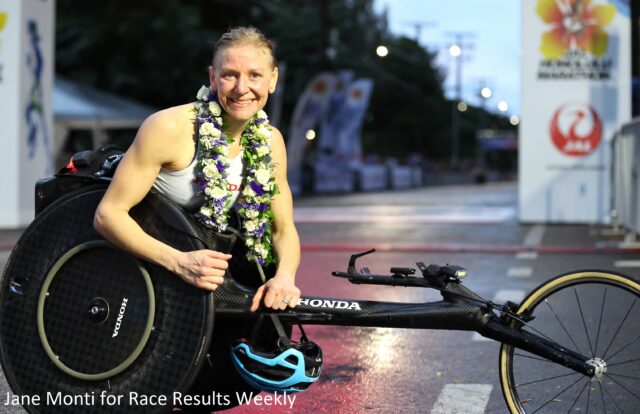
Newly crowned World Marathon Majors series champion Susannah Scaroni won the women's wheelchair division in a course record 1:48:37. It was her first time ever in Hawaii.
"I loved the energy," said Scaroni. "I loved that you could tell that you were by the ocean and lots of happy crowds, even though they were getting soaked."
Yukina Ota of Japan successfully defended his title in the men's wheelchair division, clocking a course record 1:28:25.
PHOTO: Susannah Scaroni after winning the 2025 JAL Honolulu Marathon in a course record 1:48:37 (photo by Jane Monti for Race Results Weekly)
Johnson Wins Kalakaua Merrie Mile in American Record Time
(c) 2025 Race Results Weekly, all rights reserved. Published with permission.
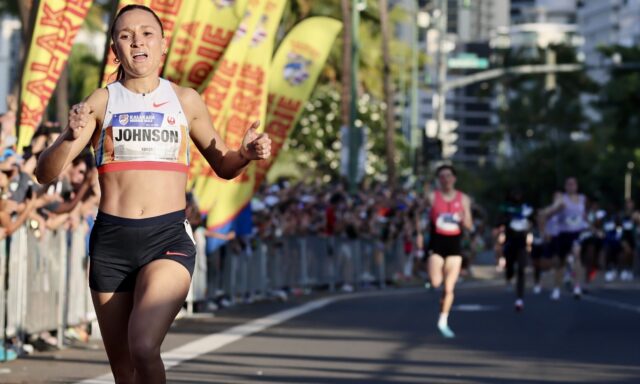
HONOLULU (13-Dec) -– Sinclaire Johnson smashed the American record in the road mile to score a convincing win at the Kalakaua Merrie Mile on a warm and windy morning here in Waikiki. The race, held in conjunction with Sunday's JAL Honolulu Marathon, featured a unique mixed-sex pursuit format. The women's elite field was given a 31-second head start over the men, with prize money awarded based on overall order of finish. For the second year in a row a runner from the women's division took first place.
Johnson went out hard at the start, following pacemaker Aurora Rynda and quickly opening a gap of more than 10 meters on the women's pack. When Rynda stepped aside two minutes into the race, Johnson was essentially running a time trial to the finish. The flat out-and-back course on Kalakaua Avenue features a hairpin turn just past the halfway point, which gave her a chance to see how much of a lead she had built. "I was kinda shocked that nobody went with me," Johnson said. "It's really hard to tell in a road mile where you are. The turnaround is actually kind of nice because of that."
Meanwhile, the men's field, led by pacer Abe Alvarado, was slowly chipping into the 31-second gap. Too slowly, in fact, as it appeared Johnson's tactics --inspired by talk the previous day of an ambitious early pace for the men-- were paying off. When Alvarado dropped out at about three-quarters of a mile, Josh Hoey, this year's world indoor champion in the 800 meters, and Hobbs Kessler, the top men's finisher at last year's Merrie Mile, were leading the charge in a tightly bunched men's pack but running out of room to get the win.
Up ahead, Johnson ran unchallenged to the finish, clocking 4:21.66 to break the U.S. record of 4:23.98 set by Krissy Gear in April at the Grand Blue Mile in Des Moines. That time also moves her to No. 2 on the all-time world list for the road mile, behind Ethiopia's Diribe Welteji, who set the world record of 4:20.98 in 2023. It was also the fastest time ever on U.S. soil. "I was pleasantly surprised with what I ran," said Johnson, who also set the American record in the track mile this season, clocking 4:16.32 at the London Diamond League meet in July. "Part of my goal this year is really trying to be fearless in races. And there's no better place to practice that than in a low-key road mile. So today I was fearless and it paid off."
And it wasn't until she turned around after the finish line that she realized how convincing her victory was. "The last 200 the fans [lining the course] got really loud and I wasn't sure if someone was coming up on me or if they were just cheering for me," said Johnson, who is coached by her fiancé, Craig Nowak, in Portland, Oregon. "That last stretch I was trying to dig deep and give it everything I had."
Nikki Hiltz, who was the overall Merrie Mile winner last year (off a 32-second head start) and won their third straight USATF title in the 1500 meters this summer, emerged from the women's pack to grab second overall in 4:24.50. Hoey closed fastest among the men and took third place in 3:54.77, passing Kenya's Susan Ejore-Sanders (4:26.47) shortly before the line, followed by Kessler (3:56.21).
"This [pursuit] format makes it much more intense," said Hoey, who arrived in Hawaii on the heels of a world indoor best in the 600 meters (1:12.84) in Boston one week earlier. "I do mostly distance training, so the 600 was kind of a fun experiment and I was happy with how that went. But really I'm a miler, so I prefer this distance. I would definitely come back and do this race again."
For the overall win, Johnson earned $10,000 (an increase from last year's $7,500 top prize). Hiltz takes home a $5,000 check as the runner-up, while Hoey scored $3,000 for third, plus a $2,500 bonus as the top male finisher (because a woman was the overall winner). Ejore-Sanders ($1,500) and Kessler ($1,000) also won prize money.
Olympic bronze medalist Yared Nuguse (3:57.25), who was the overall Merrie Mile winner in 2022, finished third among the men, ahead of Kenya's Festus Lagat (3:57.80) and New Zealand's Geordie Beamish (3:58.17), this year's world champion in the steeplechase.
Weini Kelati (4:29.83), the runner-up here last year, took fourth among the women just one week after winning the U.S. cross country title over 10-K. Japan's Nozomi Tanaka (4:30.04) placed fifth.
Earlier in the morning, the citizens' race featured 2,854 finishers, up from 2,315 in 2024. Ka'eo Kruse, a Kalaheo, Hawaii, native who now lives in Boulder Colorado, was the men's winner, in 4:17.21. "Just being able to represent Hawaii and winning a home race felt great," said Kruse, who competed collegiately at Harvard and the University of Virginia and was an elite triathlete. "These guys are good, they were pushing it, so I just bided my time and waited for the right spot to make my move. I'm pretty confident in my kick."
Great Britain's Hollie Parker, who finished seventh in the 1500 at this year's U.K. championships, won the women's division in 4:46.25 after only deciding to hop into the race one day earlier. "Better than a Friday workout," she said with a laugh. "It felt like a sprint. On the road, a mile is really hard to feel so I was just sprinting the whole way."
PHOTO: Sinclaire Johnson winning the 2025 Kalakaua Merrie Mile in 4:21.66 setting a new American record (photo by Jane Monti for Race Results Weekly)

Sinclaire Johnson To Test Her Fitness At Kalakaua Merrie Mile
(c) 2025 Race Results Weekly, all rights reserved. Published with permission.
HONOLULU (12-Dec) -- Sinclaire Johnson's professional running career has often felt like a roller coaster ride. A pandemic, stints with two training groups and countless injuries stood in the way of consistency for the 2019 NCAA champion in the 1500 meters. Along the way there were highs (a 2022 USATF national title in the 1500) and lows (an agonizing fourth-place finish at the 2024 Olympic Trials) and frustration. That all changed over the past year, in which the Oklahoma State grad thrived under the coaching of her fiancé, stayed injury free, made her second World Athletics Championships team, and broke the American record in the mile.
Now the 27-year-old Florida native has returned to Honolulu to race Saturday in the Kalakaua Merrie Mile road race for the second year in a row. The Waikiki event, held in conjunction with the JAL Honolulu Marathon, features a unique mixed-sex pursuit format for the elite athletes, with the women's field getting a head start over the men.
Last year, for the first time since the event began in 2016, an athlete from the women's field took the crown. After a 32-second heat start, Nikki Hiltz crossed the line first, followed closely by Weini Kelati and Johnson, then Hobbs Kessler was the first man to finish, a fraction of a second behind. "This race last year was a lot of fun, I definitely wanted to put it in on my calendar again," Johnson told Race Results Weekly. "This is the end of the year, but it's kind of opening up the 2026 racing season."
At last year's Merrie Mile, Johnson was looking to get past the disappointment of her fourth-place showing at the Olympic Trials, when she missed a spot for the Paris Games by one place. But there was a silver lining: She recorded a lifetime best of 3:56.75, making her the sixth-fastest American 1500 runner of all-time. "That race is so interesting to look back on because I wouldn't have done anything differently," she says. "I PR'd by two seconds and I also ran a race that I was really proud of. I attacked it and went for it. It just didn't come together on the day." And it coincided with a major turning point in her career. "In a way it was a blessing disguise, which sounds weird because obviously I would have loved to make the Olympic team, but it really forced me to make changes that were necessary."
Chief among them was parting ways with coach Pete Julian and the Union Athletic Club and starting to train under the eyes of her fiancé, Craig Nowak, in Portland, Oregon. "We've been together for almost nine years at this point, and we met in college, so Craig has seen me through our college coach [Dave Smith], then Jerry Schumacher, who was my first pro coach [at Nike's Bowerman Track Club], and Pete Julian. He's had a first-hand look at how I've responded to certain training aspects. And he himself is a pretty good runner, too, so he understands the ins and outs of this niche sport."
Nowak won multiple Big 12 titles at Oklahoma State and then was a national-class steeplechaser for several years. Now essentially retired from pro racing, he guides Johnson's training and often joins her for some of her workouts. "I feel like focusing on health has been the number one change we've made," he says, a nod to the fact that two separate injuries in 2024 alone limited her racing. "And also focusing on where we are now instead of thinking so far in the future. Thinking about all the big things you want to do can sometimes make coaches act too aggressively in the now instead of seeing where you are and building from there."
The results of this new dimension to their relationship were immediate. Johnson remained healthy all year. She was the runner-up to Hiltz at the USATF Championships indoors and out, both times qualifying for the world championships. (She finished sixth indoors in Nanjing, China, and 13th outdoors in Tokyo.) In between she placed fourth in the mile at the London Diamond League, clocking 4:16.32 and slicing three hundredths of a second off Hiltz's U.S. record. "I knew it was going at a pretty aggressive pace and I felt like I should take advantage of that," Johnson says. "Doing it at the London Stadium in front of 60,000 fans, it's really hard to explain how cool that was. It was a very special race that I'll remember for the rest of my career."
On Saturday she'll complete her competitive year in Honolulu. "I really like the format of this race where the men are chasing the women. It feels very pure, like you're running away from the boys in elementary school again," she says with a laugh. "And it's also just a nice time of the year where it's fun to break up fall training and see where your fitness is. It's not a high-stakes race, it's really just for fun. We're going to go run hard, but we're here to enjoy and celebrate all we've done this year."
Plus, there's a hefty financial incentive to do well. The gap between the women's and men's starts will be down by one second from last year, to 31. Prize money is awarded based on overall order of finish to the top five ($10,000, $5000, $3000, $1500 and $1000) and the top finisher in the men's or women's category who is not the overall winner will receive a special bonus of $2500. There will also be a $10,000 bonus for a world record in the road mile (3:51.3 for the men and 4:20.98 for the women). "The caliber of the women's field is really strong and if we really push that first half and continue hard to the finish line then I think we have a really good shot at beating the guys," Johnson says.
Then it's on to 2026, during which Johnson hopes to make the U.S team for March's World Athletics Indoor Championships and compete for a medal, then earn a spot at the inaugural World Athletics Ultimate Championship in September (one week before her wedding). "It is an off-year, but there's still a lot of opportunity," she says. "I think the way that we look at it is that these are building blocks to L.A. 2028 [the next Summer Olympics]. I'm really looking forward to seeing how having this past year under my belt is going to help me progress throughout the year."
PHOTO: Sinclaire Johnson on the track at the 2025 World Athletics Championships in Tokyo in September (photo by Jane Monti for Race Results Weekly)