Article
Expect More "Mini Magic" On June 7 In New York City
(c) 2025 Race Results Weekly, all rights reserved. Published with permission.
(29-May) -- Organizers of the 53rd edition of the Mastercard New York Mini 10-K on Saturday, June 7, in New York City have released their elite field, and it's truly stellar. New York Road Runners officials said yesterday that the Mini --the world's first-ever road race for women, founded in 1972-- would boast 17 Olympians and Paralympians, Olympic and World Championship medalists, Abbott World Marathon Majors champions, and arguably the best field of American distance women assembled outside of a national track championships. The race is also sold out with over 10,000 entries.
"I always look forward to the Mastercard New York Mini 10K, and I'm excited to race it for the fourth year in a row," said two-time USA Olympian Emily Sisson, who just set a 10K personal best of 31:03 in Manchester, England, last Sunday. "It's a special chance to reconnect with my Olympic teammates, compete with some of the top women athletes, and run alongside 10,000 inspiring women brought together by a shared love of the sport."
At the front of the race, 2024 Kenyan Olympic teammates Hellen Obiri and Sharon Lokedi will renew their road racing rivalry. At the Paris Olympics last August Obiri finished one place ahead of Lokedi, taking the bronze medal with Lokedi just four seconds behind. But at this year's Boston Marathon it was Lokedi who finished ahead of Obiri, winning her first Boston Marathon and her second Abbott World Marathon Majors event. She was the runner-up to 2024 Mini champion, Senbere Teferi of Ethiopia, who will not be defending her title this year.
"New York City has been a special place for me ever since I won the 2022 TCS New York City Marathon in my debut," Lokedi said through a media release. "I'm excited to be back competing in Central Park after winning my first United Airlines NYC Half in March and the Boston Marathon (in April) to continue the momentum as I take on my third Mastercard New York Mini 10K."
Three other athletes from Africa --Gotytom Gebreslase of Ethiopia, and Grace Nawowuna and Viola Cheptoo of Kenya-- also hope to add their names to the Mini's prestigious winners' list. Gebreslase was the 2022 world marathon champion in Eugene, Ore., and won the silver medal at the 2023 edition of the World Athletics Championships in Budapest in 2023. Nawowuna, who is only 21, was fourth at the 2023 World Athletics Cross Country Championships and has a fast 30:27 10-K personal best. Cheptoo, a younger sister of five-time world indoor/outdoor track champion Bernard Lagat, was the runner-up at the 2021 TCS New York City Marathon. She is coming back from a hip injury.
The strength of the American field is noteworthy. With the USATF Outdoor Track & Field Championships scheduled to begin in late July instead of the usual late June, USA athletes have a clear window to compete at the Mini and have plenty of time to recover for the track championships. That allowed many of the very best 10K women --Weini Kelati, Taylor Roe, Sisson, Amanda Vestri, Emma Grace Hurley, Emily Durgin, Emily Infeld, Annie Frisbie, Dakotah Popehn, and Erika Kemp-- to all compete at the race.
Kelati, the 2024 USA Olympic Trials 10,000m champion, has never competed at the Mini. She has a fast 10K personal best of 30:50 set en route to her national half-marathon record of 1:06:09 at the Aramco Houston Half-Marathon last January. Roe --who is the USATF 10K record holder with a 30:56 personal best set en route to her national 10-mile record and world best of 49:53 at the Credit Union Cherry Blossom 10-Mile last month-- is also a Mini rookie. Vestri had a breakthrough performance at last year's Mini, finishing fourth in a personal best 31:17, and Hurley was the runner-up to Roe at the 2025 USATF Half-Marathon Championships in Atlanta. She just ran a personal best of 31:00 in Tokyo on May 3.
Susannah Scaroni hopes to win the professional wheelchair division of the Mini for the sixth time. The four-time Paralympian and recent Boston Marathon champion broke her own event record in the wheelchair division the last time she competed in 2023, and has won all five editions of the professional wheelchair division since it was added to the Mini in 2018.
"I'm thrilled to return to the Mastercard New York Mini 10K and defend my title for the sixth time," Scaroni said through a statement. "It's always such an empowering race that brings together world-class athletes, women of all ages, and girls representing the future of the sport participating in the (companion) Girls Run."
Some of the best women in the history of distance running have been Mini champions including Norway's Grete Waitz (five wins between 1979 and 1984), Kenya's Tegla Loroupe (five wins between 1993 and 2000), the Netherlands' Lornah Kiplagat (four wins between 2003 and 2007), Britain's Paula Radcliffe (2001), and Kenya's Mary Keitany (three wins from 2015 to 2018). The last American athlete to win the Mini was Sara Hall in 2021.
The 2024 Mini, which was held in sunny and warm conditions, had a race-record 9,688 finishers.
ENTRY LIST - ELITE RUNNER DIVISION
Hellen Obiri (KEN), Boulder, Colo., 30:15 (Manchester, 2022)
Grace Nawowuna (KEN), Iten, Kenya, 30:27 (Lille, 2024)
Gotytom Gebreslase (ETH), Addis Ababa, Ethiopia, 30:32 (Manchester, 2024)
Weini Kelati (USA), Flagstaff, Ariz., 30:50+ (Houston, 2025)
Sharon Lokedi (KEN, Flagstaff, Ariz., 30:52 (Mini, 2022)
Viola Cheptoo (KEN), Iten, Kenya, 30:55 (Phoenix, 2019)
Taylor Roe (USA), Raleigh, N.C., 30:56+ NR (Washington, D.C., 2025)
Emma Grace Hurley (USA), Indianapolis, Ind., 31:00 (Tokyo, 2025)
Emily Sisson (USA), Providence, R.I., 31:03 (Manchester, 2025)
Laura Galvan (MEX), Guanajuato, Mexico, 31:14 (Mini, 2023)
Amanda Vestri (USA), Boone, N.C., 31:17 (Mini, 2024)
Emily Durgin (USA), Flagstaff, Ariz., 31:35 (Mini, 2023)
Juliette Thomas (BEL), Brussels, Belgium, 31:41 (Valenciennes, 2025)
Emily Infeld (USA), Portland, Ore., 31:47 (Boston, 2013)
Annie Frisbie (USA), Hopkins, Minn., 31:49 (Mini, 2024)
Dakotah Popehn (USA), Burnsville, Minn., 31:58 (Mini, 2024)
Florencia Borelli (ARG), Buenos Aires, Argentina, 31:59 (Miramar, Fla., 2023)
Fionnuala McCormack (40+/IRL), Dublin, Ireland, 32:08 (Meath, Ireland, 2022)
Erika Kemp (USA), Providence, R.I., 32:14 (Boston, 2022)
Stephanie Bruce (40+/USA), Flagstaff, Ariz., 32:21 (Atlanta, 2018)
Susanna Sullivan (USA), Reston, Va., 32:24+ (Houston, 2025)
Emily Venters (USA), Salt Lake City, Utah, 32:31 (Boston, 2023)
Tristin Colley (USA), Boone, N.C., 32:34 (New York, 2023)
Yuka Ando (JPN), Tokyo, 32:37 (Okayama, 2012)
Kim Conley (USA), Flagstaff, Ariz., 32:38 (Boston, 2015)
Dani Polerecky (USA), Flagstaff, Ariz., 32:57 (Mesa, Ariz., 2024)
Rose Harvey (GBR), London, England, 32:59 (Manchester, 2024)
Annamaria Kostarellis (USA), Albuquerque, N.M., 33:09 (Northport, N.Y., 2024)
Jackie Gaughan (USA), Boston, Mass., 33:19 (Cape Elizabeth, Maine, 2024)
Megan Hasz (USA), Dorchester, Mass., 33:22 (Boston, 2024)
Mica Rivera Wood (PER), Logan, Utah, 33:33+ (Houston, 2025)
Gabi Rooker (USA), Minneapolis, Minn., 33:33+ (Atlanta, 2025)
Anna Oeser (USA), Brookline, Mass., 33:43 (Boston, 2023)
Alexandra Lucki (CAN), Boston, Mass., 33:57 (Toronto, 2021)
Khia Kurtenbach (USA), New York, N.Y., 34:18 (New York, 2025)
Sara Vaughn (USA), Boulder, Colo., 34:38 (Boston, 2022)
Aileen Barry (40+/USA), Manhasset, N.Y., 35:04 (New York, 2009)
Alyssa Salese (USA), Huntington, N.Y., 35:26 (Mini, 2022)
Alexandra Conway (USA), New York, N.Y., 36:07 (Flushing, N.Y., 2023)
Abigail Shoemaker (USA), New York, N.Y., 37:36 (New York, 2022)
Katarina Mayer (CAN), New York, N.Y., 38:04 (New York, 2025)
Kathryn Fluehr (USA), Boulder, Colo., Debut
Bailey Hertenstein (USA), Boulder, Colo., Debut
Kidan Kidane (USA), New York, N.Y., Debut
Felicia Pasadyn (USA), New York, N.Y., Debut
____________
+Time achieved en route to a longer distance
ENTRY LIST - ELITE WHEELCHAIR DIVISION -
Susannah Scaroni (USA), Champaign, Ill., 21:06 (Mini, 2023)
Tatyana McFadden (USA), Baltimore, 23:14 (Atlanta, 2016)
Hannah Dederick (USA), Champaign, Ill., 25:28 (Mini, 2022)
Michelle Wheeler (USA), Dallas, 26:04 (Mini, 2023)
Hoda Elshorbagy (EGY), Champaign, Ill., 26:52 (Boston, 2024)
Chelsea Stein (USA), Spring, Texas, 28:24 (Atlanta, 2024)
Linden Williamson (USA), Boerne, Texas, 30:27 (Atlanta, 2024)
April Coughlin (USA), New York, 38:16 (Mini, 2024)
Rachel Cleaver (USA), Beloit, Texas, Debut
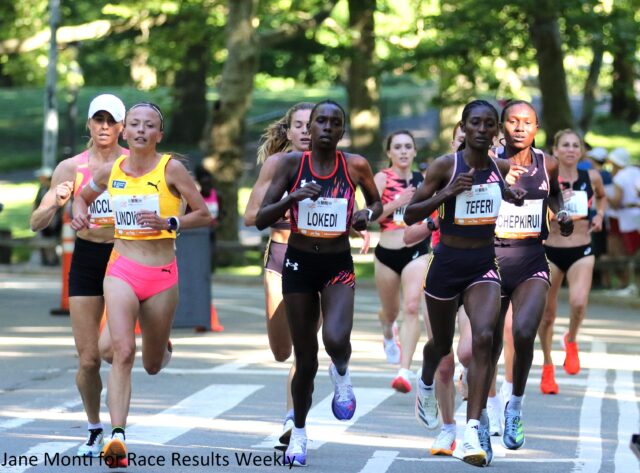
PHOTO: The lead pack at the two-mile mark of the 2024 Mastercard New York Mini 10-K (left to right), Jess McClain, Dakotah Popehn, Emily Durgin (partially obscured), Sharon Lokedi, Emma Grace Hurley, Annie Frisbie (mostly obscured), Senbere Teferi, Sheila Chepkirui, and Sara Hall (photo by Jane Monti for Race Results Weekly)

Korir, Chelangat Take Ottawa Marathon Titles
(c) 2025 Race Results Weekly, all rights reserved. Published with permission.
OTTAWA (25-May) -- After several days of rainy and unseasonably cold weather, the sun finally came out here in the Canadian capital and it shone brightest on Albert Korir and Mercy Chelangat. The two Kenyans won the 51st edition of the Tartan Ottawa International Marathon by comfortable margins. For Korir, who clocked 2:08:22, this was his second victory here (he also won in 2019). For Chelangat, who was timed in 2:23:33, today's race was her first-ever marathon. Both winners earned CAD 20,000 in prize money (=USD 14,560).
KORIR GOES IT ALONE
The men's race began with a tightly-bunched pack following two pacemakers through 5K in 15:06 and 10K in 30:08, on pace to run in the 2:06's. Korir was right in front of the pack along with Canadian Rory Linkletter, American C.J. Albertson, and Ethiopians Demeke Tesfaye and Belay Tilahun. Everybody looked comfortable.
But Korir --who had originally planned to run the Boston Marathon last month, but had to withdraw due to an ankle injury-- was itching to run faster.
"I was feeling good so I was seeing the pacer was, like, slow," Korir told Race Results Weekly. "I had to push and I had it on my mind that I had to win this one."
The pack held together on the climb up Alexandra Bridge where the runners move from Ontario to Quebec, but soon after Korir decided to make his move. He ran 2:56 for the 20th kilometer, dropped his pacer, and opened up a gap on the rest of the field. By the time he hit halfway (1:03:12) he had an 18-second lead on Linkletter and Albertson. The two Ethiopians had fallen even further behind.
From there, Korir ran alone. Wearing bright red adidas kit, he clicked off the kilometers and repeatedly looked at his watch and shot glances behind him to see if anyone was catching up.
"I was trying to keep the distance, and I was also trying to track them not to close the gap," Korir explained.
Korir's lead inched-up to 22 seconds by 30K, and 28 seconds by 35K. He seemed to have the win in his pocket, but Linkletter felt he had enough energy left to try to close the gap. The Canadian Olympian picked up his pace.
"Honestly, I didn't feel that good the first 30K," Linkletter told reporters. "Like, it was fine, but I wasn't full of confidence that I was going to make the distance." He continued: "Like, at some point I've got to see if I can close this gap a little. With 5-K to go I was like, let's run 1-K hard and see how much I can close it down. I was closing it, but not enough, not fast enough."
Linkletter's move brought him within nine seconds of Korir by the finish, and his time of 2:08:31 was the fastest ever recorded by a Canadian on Canadian soil. It also put him 24 seconds ahead of Albertson who clocked 2:08:55, the second fastest time of his career. The American was surprised that he survived in the second half after running 1:03:20 in the first. Both he and Linkletter had run the Boston Marathon five weeks ago.
"I ran pretty fast," Albertson told Race Results Weekly. "I think Brooks is making some good shoes because I don't know how I ran that fast with my training, but it was nice."
CHELANGAT RUNS HER OWN RACE
Chelangat, and her HOKA Northern Arizona Elite coach Jack Mullaney, had a plan for today's race. She was supposed to follow the male pacers in the first half and not think about much else. But that plan fell apart when the pacers were moving too quickly, about 10 seconds per mile too fast, and she decided to drop back. Watching the race broadcast it was easy to think that she had been dropped, but she had made a decision.
"I was just like, I'm going to run my own race," Chelangat told Race Results Weekly. "We were kind of going so fast, like faster than the (planned) pace at the beginning. It was like 5:20's, low, like every time, every mile. So, they were kind of going fast, so I was not sure how I'm going to feel at the end because that's not how you want to start your first marathon."
Chelangat ran 1:10:59 for her first half, and split 1:51:36 at 30K. That put her 14 seconds behind Ethiopians Meseret Gebre and Fantu Shugi. Chelangat was feeling good, but she was dealing with another challenge. She was having trouble opening the drinking tips of her bottles. She ended up unscrewing the tops and drinking from the wide opening, instead.
"I had to open the water thing and like chug it," she said, pointing to the dried sheen of energy drink that had spilled on her legs.
In the 34th kilometer she caught up to Gebre who had previously dropped Shugi (she would later drop out). The pair briefly ran together before Chelangat began to pull away escorted by male pacers Andrew Alexander and Sammy Kirongo. From there she expanded her lead with every kilometer, eventually finishing almost five minutes ahead of her nearest rival, Visiline Jepkesho of Kenya, who ran 2:28:09. Gebre had a very tough second half and finished third in 2:30:46 (she ran halves of 1:10:57 and 1:19:49).
After hugging his star athlete, Coach Mullaney spoke to Race Results Weekly. "I don't know if I have the words right now," said Mullaney, who was clearly emotional. "I'm just so happy for her because she made a conscious decision two months ago that she was going to embrace everything that it meant to be a marathoner, and just own the 24/7 process." He added: "She was smart. She worked hard, she showed some true grit, and I'm just so proud of her."
Chelangat's time was the fastest-ever by a HOKA Northern Arizona Elite woman, eclipsing the 2:24:28 Kellyn Taylor ran at Grandma's Marathon in 2018. Chelangat already had the club record for the half-marathon of 1:08:57.
Paige Wood, Chelangat's teammate, also ran in today's marathon as a pacemaker. She ran with the lead group for about 26 kilometers before dropping out. She plans to run Grandma's Marathon in Duluth in June.
PHOTO: Albert Korir of Kenya celebrates after winning the 2025 Tartan Ottawa International Marathon (photo by Jane Monti for Race Results Weekly)
Mercy Chelangat To Make Marathon Debut In Ottawa On Sunday
(c) 2025 Race Results Weekly, all rights reserved. Published with permission.
OTTAWA (23-May) -- Mercy Chelangat, the 2022 NCAA 10,000m champion for the University of Alabama, is finally ready to step up to the marathon. The 27 year-old Kenyan, part of the Hoka Northern Arizona Elite team in Flagstaff, Ariz., will run the 42.195-kilometer distance for the first time here on Sunday at the 51st Tartan Ottawa International Marathon, and she's excited that she chose the Canadian capital to make her marathon debut.
"We had like a couple of options, and we liked this one because it's closer; I didn't have to travel really far," she told Race Results Weekly in an interview this morning. She continued: "I don't really like a lot of pressure, so I really didn't want to put myself in a (World Marathon) Major and have that kind of pressure put on me. So, we just decided to do this one."
Still, Chelangat will be running with some fast women, including Kenyans Visiline Jepkesho (2:21:37 personal best) and Philes Ongori (2:23:32), and Ethiopians Meseret Gebre (2:23:11) and Bontu Bekele Gada (2:23:39). She said that she has a simple race plan.
"Just try to hang if my legs will allow me," Chelangat said with a laugh. "I will try to hang as much as possible because we have some pacers who are going to help us, so I'm just hoping to hang with them as much as I can."
To get ready for Sunday's race, Chelangat returned to her native Kenya in February and March and began to lay down her base. Before this training block, she had never run 100 miles a week. But, after informally joining-up with some training groups in Kenya that kind of mileage became the norm, according to her coach Jack Mullaney.
"Right after the Houston Half in January she went back home to Kenya," Mullaney said in an interview. "For about six weeks she started hopping in with a few marathon groups over there. I think she really understood what it meant to be a marathoner when she did that. She was over there training and I happened to text her and I said, 'Mercy, that was a hundred-mile week this week.' She goes, 'Oh, it was?'"
Mullaney explained that except for her long run and rest days, she was basically doubling 10K every day.
"Seeing the level of what it takes to be an elite marathoner was really pivotal for her to take that next step in training," Mullaney said. She's now put in eight 100-mile weeks in the lead-up to this before she started tapering."
After returning from Kenya, Chelangat did one race as a fitness test. Still deep into her marathon miles, she ran a solo 1:10:32 at the OneAmerica Mini-Marathon, a half-marathon in Indianapolis on May 3. She ran the first eight miles conservatively, then cut down to a 5:10 per mile pace by the finish. She clocked 1:10:32 and felt very comfortable. But, all of the accumulated miles had left her fatigued and needing a lot more food.
"Really tired," she said when asked how her body had responded to marathon training. She continued: "I'm really hungry in the mornings now; I eat a really good breakfast. I make sure I'm eating through the day, for sure."
Chelangat and Mullaney are clearly on the same page as far as the goal pace for Sunday. Both said that 5 minutes and 30 seconds per mile (or a little faster) through 30-K would be great. That should give her enough remaining energy to drop down a little for the last 12 kilometers and shoot for a 2:23 finish. The women's course record here is 2:22:17 by Gelete Burka of Ethiopia in 2018.
"She can really turn her brain off for the first half to 30-K of this thing and just tuck in behind the pacers," Mullaney said. He continued: "We feel like 5:25 to 5:30 (pace) is a pretty good range for her on Sunday."
But like every first-time marathoner, Chelangat sees getting to the finish line as her primary goal.
"Finishing is going to be a success for me, because this is a new distance for sure," said Chelangat. "So, I don't know how my body and my legs will respond. Now I've done my part of training, I've done everything I could, but we don't know. Getting to the finish line will be success for me, for sure."
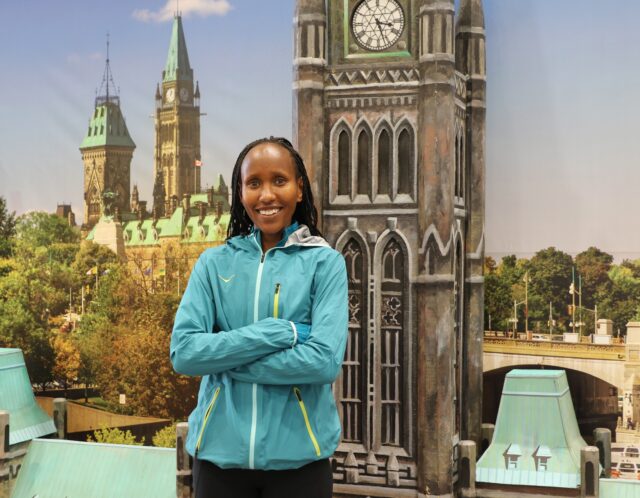
PHOTO: Mercy Chelangat of Hoka NAZ Elite at the pre-race press conference for the Tartan Ottawa International Marathon (photo by Jane Monti for Race Results Weekly)
RRW: What Did it Take to Earn $1000 at a Road Race in 2024?
(c) 2025 Race Results Weekly, all rights reserved. Published with permission.
(16-May) -- A woman running a 2:38:49 marathon. A man running a 14:06 5K. A woman running a 34:34 10K. A man running a 1:04:14 half-marathon.
What did all of those 2024 road running performances have in common? They all generated a $1000 prize money payment, just four of a total of 235 one thousand dollar (or one thousand euro) payments recorded by Race Results Weekly (RRW) last year. RRW sifted through the results of thousands of road races to determine what it took to make $1000 in prize money.
Not surprisingly, the range of those performances was very broad, from truly world-class marks to times more typically associated with recreational runners.
For instance, in the marathon --where RRW flagged 90 one thousand dollar payments (45 to men and 45 to women)-- the average time to earn $1000 was 2:39:10 for women and 2:16:37 for men. The average finish place for $1000 payments was 5.4 for women and 5.5 for men. The range of times to earn $1000 was huge, from 2:23:52 to 3:10:24 for women, and 2:07:09 to 2:30:50 for men.
At the top end of the performance scale, Kenya's Linet Masai finished seventh at the Mainova Frankfurt Marathon last October in 2:23:52 and earned €1000 (equaling $1080 at the time). On the men's side, Italy's Eyob Faniel finished seventh at the Zürich Maratón de Sevilla in 2:07:09, also earning €1000. For comparison, running the same times at the TCS New York City Marathon a week later, both Masai and Faniel would have earned $100,000 and been the race winners (theoretically, at least).
At the other end of the scale, American Meredith Steely ran 3:10:24 (2nd place) at the high-altitude Boulderthon Presented by Puma in Colorado and earned $1000, the slowest marathon mark in the RRW list. At the same race Esteban Trujillo finished second on the men's side and clocked 2:30:50. His performance was also good for $1000.
Looking across the most popular distances, these were the fastest and slowest performances to earn $1000 (or €1000):
Fastest marks to earn $1000:
Men Women
Mile 3:51.9 4:20.4
5K 13:44 15:25
10K 27:29 30:38
Half-Marathon 59:21 1:07:08
Marathon 2:07:09 2:23:52
Slowest marks to earn $1000:
Men Women
Mile 4:09.1 4:44.5
5K 14:10 16:47
10K 30:23 36:38
Half-Marathon 1:08:21 1:18:35
Marathon 2:30:50 3:10:24
Comparing results over a range of distances and events highlighted the diversity of the global road running scene. Some races use pacemakers and are speed-oriented, while others are held championship-style with no pacers. Some events have flat courses at sea level, while others are contested on hilly courses at altitude. Some events pay larger appearance fees in relation to their prize money, while others pay no appearance fees and only offer prize money. Some races have travel budgets which allow top athletes to participate no matter where they live, while others have no travel budget and can only support athletes who live near the race.
In addition many organizers offer special prize money for home-country athletes, and this is especially true in the United States. For instance, Race Results Weekly only credited Henry Wynne for the $1000 he earned for eighth place at the Asics Falmouth Road Race last August. However, he also earned an additional $2000 for being the second American.
A complete list of all of the payments is here (file sorted chronologically, from January to December):
https://docs.google.com/spreadsheets/d/1TVlun8M7xh4ysw3GLstGNTRsTAPOGoK7sYy-uRGkiuw/edit?usp=sharing
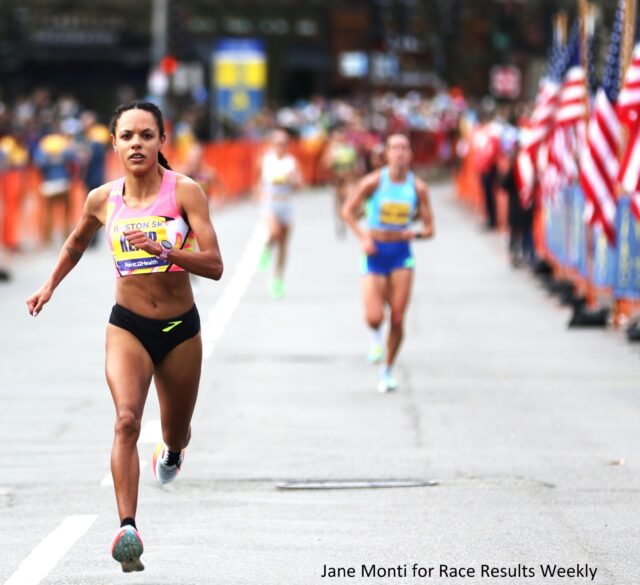
PHOTO: Erika Kemp finishing fifth in 15:25 at the 2024 Boston 5-K presented Point32Health where she earned $1000 in prize money (photo by Jane Monti for Race Results Weekly)
Korir, Lokedi Win 2025 Boston Marathon in Fast Times
(c) 2025 Race Results Weekly, all rights reserved. Published with permission.
BOSTON (21-Apr) -- Cool temperatures, brilliant sunshine and only light winds helped Kenyans John Korir and Sharon Lokedi win their first Boston Marathon titles here today in fast times. Korir, 28, broke the race open with a powerful surge in the 20th mile and scampered to the finish line on Boylston Street alone in a quick 2:04:45. Lokedi, 31, won a two-way battle with compatriot and two-time defending champion Hellen Obiri in the 26th mile and smashed the course record by more than two and a half minutes, clocking 2:17:22. Both athletes won $150,000 in prize money, and Lokedi earned an additional $50,000 bonus for breaking the course record.
KORIR GOES FROM THE PAVEMENT TO THE PODIUM
Korir's race got off to an awful start. About 100 meters into the competition he was tripped from behind and fell, ripping off his bib number.
"I fell at the start," Korir told reporters after the race. "I said, 'should I stay down or get up?'"
He regained his feet quickly, tucked his crumpled bib into his shorts, and was running in 12th place by the 5-kilometer checkpoint, just two seconds behind the leaders Conner Mantz and Clayton Young of the United States, Patrick Tiernan of Australia, Yemane Haileselassie of Eritrea, and Wesley Kiptoo of Kenya. In all, about 21 men were running together.
Korir, following the plan set forth by his coaches, Ron Mann and Haron Lagat, and his brother, Wesley Korir (the 2012 Boston Marathon champion) Korir stayed "quiet," just grinding out the miles within the pack. The pace was more than honest. Through 20 kilometers the men surpassed all of the checkpoint times recorded by Kenya's Geoffrey Mutai when he set the course record of 2:03:02 in 2011.
"I was surprised at how many people were in that pack (going so fast)," Mantz said at the post-race press conference. "The pack was quite large through halfway, and it was quite large at the 18-mile mark, and I was a little concerned."
Indeed, there were 16 men within two seconds of the halfway leader, Canada's Rory Linkletter, including last year's champion Sisay Lemma. Like earlier in the race, Korir remained in the pack, waiting.
In the famously downhill 16th mile, the pack ran a blistering 4:32 split. That was too much for Lemma who dropped out. Korir stayed tucked-in, then surged hard past the 20-mile mark just as Heart Break Hill begins.
"For me, that was the plan," said Korir. "We planned that with my coach and my brother."
Korir, last October's Bank of America Chicago Marathon champion, stunned the field with a 4:39, uphill split. In one mile, he built an 18-second lead which grew to 39 seconds by 35 km. Beginning with mile-20, he ran mile splits of 4:41, 4:39, 4:24, 4:38, and 4:41. By the 24-mile mark he was up by 55 seconds and everybody else was running for second.
"It worked very well," said Korir matter of factly about his move. "And I'm happy."
Korir spread his arms as he crossed the finish line, and was immediately embraced by his brother. The Korirs became the first brothers to win the Boston Marathon, and John Korir became the first man since Robert Kipkoech Cheruiyot to win the Chicago Marathon in the fall then Boston the following spring (Cheruiyot did it in 2006 and 2007).
Korir said that he did the same training for Boston as he did for Chicago, despite the fact that the Chicago course is completely flat.
"We did the same like Chicago," Korir said, adding, "We repeated it for Boston."
Behind Korir, a terrific battle was playing out for second place. Mantz, Tanzania's Alphonce Simbu and Kenya's Cybrian Kotut were running together. Mantz tried to make a move to break up the pack, but his legs just didn't have the snap that he had hoped.
"Over the last 1000 (meters) there were three of us," said Mantz. "I made a hard move and they responded as if I wasn't making any moves. It was a little bit humbling."
Simbu and Kotut pulled away from Mantz, who would finish fourth in a personal best 2:05:08, the second-fastest time by an American at Boston. The two Africans ran side-by-side until just a few meters from the finish where, sprinting in earnest, Simbu got a step on Kotut. Both men were timed in 2:05:04, but Simbu got second and Kotut --a younger brother of former New York City Marathon champion Martin Lel-- took third. Debutante Muktar Edris of Ethiopia was fifth in 2:05:59, and Canada's Linkletter --the race leader at halfway-- took sixth in 2:07:02, the fastest Boston Marathon ever by a Canadian.
LOKEDI AND OBIRI DO BATTLE AGAIN IN THE WOMEN'S RACE
After a gentle opening mile of 5:46, the elite women made the collective decision to ramp-up the pace. With Ethiopia's Rahma Tusa on the front, they hit 5K in 16:49, then dropped way down to 16:02 for the next 5K (32:51 at 10-K). Remarkably, 15 women were willing to stay with that pace, just 13 seconds slower than the course record pace set by Ethiopia's Buzunesh Deba in 2014.
"The pace was hot from the start and I think that played out well for me," said Lokedi. "It was like go, go, go, go go."
The lead women were just about level with course record pace by 15-K (49:10), but were well under that pace after Ethiopia's Yalemzerf Yehualaw split the next five kilometers in 15:54. Only Lokedi, Obiri, Ethiopia's Amane Beriso and Kenya's Irine Cheptai could hold that pace. That group of five hit halfway in 1:08:46, and 25K in 1:21:22. That put them about one minute under course record pace. Lokedi loved the fast pace.
"I was really grateful for them pushing from the start," said Lokedi. "Because I think that's what made the outcome what it was."
Cheptai was the first to fall off (she was 12 seconds behind by 30-K), then Beriso faded back by 35K. Lokedi, Obiri and Yehualaw stayed together through 24 miles (which went into the books at a blistering 4:53). Lokedi was doing all of the leading, and she motioned to Obiri to come up and help her (she did not).
Early in the 26th mile, Obiri tried to surge away. Lokedi immediately covered that move, then put in a surge of her own. That was the decisive blow. Lokedi ran the final mile in 5:04 (25.2 to 26.2), and that gave her a gap of 19 seconds over Obiri (2:17:41). Yehualaw held on for third (2:18:06), and all three women broke Deba's course record.
"I just tried to say, 'stay strong and keep fighting,'" Lokedi said. "Fight, fight, fight, fight."
Cheptai took fourth in 2:21:32, and fifth went to Beriso in 2:21:58. Jess McClain was the top American in seventh. Moving up from 16th place at halfway, she clocked 2:22:43, tying Joan Benoit's fourth-fastest time by a USA woman at this race set in 1983. McClain, who finished fourth at the 2024 USA Olympic Team Trials Marathon, was delighted with her finish.
"First American is amazing, for sure," said McClain, who did much of her training in the pre-dawn hours in Phoenix where she lives. She added: "Today it felt like a win for me."
HUG GETS NUMBER 8
Switzerland's Marcel Hug won his 8th wheelchair title by over five minutes over American Daniel Romanchuk, clocking 1:21:34. The win was particularly special for Hug because Bob Hall, the race's first wheelchair champion 50 years ago, was in attendance.
"It's a really special moment," Hug told reporters. He continued: "He opened the door for us to be able to participate here."
American Susannah Scaroni won her second Boston title, defeating Switzerland's Catherine Debrunner with a fearless descent in the 16th mile.
"My years of experience gave me a lot of confidence not to brake on that hill," Scaroni said. She added: "I think I was just a little bit less cautious there. Then we went into my favorite part, the uphills."
Scaroni won by more than two minutes. Like Hug, she won $50,000 in prize money.
By 3:15 p.m., 21,727 runners had crossed the finish line (of about 28,928 starters). The official number of finishers will not be known until tomorrow.
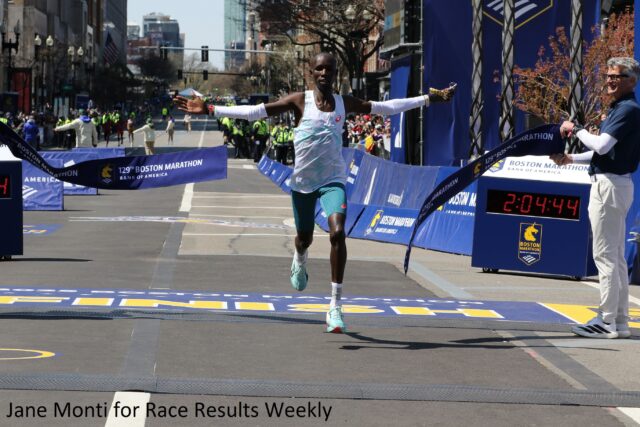
PHOTO: John Korir of Kenya winning the 2025 Boston Marathon in 2:04:45 (Photo by Jane Monti for Race Results Weekly)