Article
Once An "Underdeveloped Athlete," Mackay To Close Breakthrough Season On Fifth Avenue On Sunday
(c) 2024 Race Results Weekly, all rights reserved. Reprinted with permission.
NEW YORK (07-Sep) -- Emily Mackay, who considered herself an "underdeveloped athlete" when she finished her collegiate running career at Binghamton University in Upstate New York two summers ago, took a massive leap forward this year winning a World Athletics Indoor Championships bronze medal at 1500m, lowering her 1500m personal best to 3:55.90 (third fastest ever by an American), and becoming an Olympic semi-finalist after taking second at the USA Olympic Trials. The 26 year-old from Endicott, N.Y., who will run the New Balance Fifth Avenue Mile here tomorrow, can hardly believe it.
"I had no idea what to expect, and it surpassed my expectations in every way," Mackay told an audience of runners gathered today at New York Road Runners' RunCenter on Manhattan's West Side. "It was really, really special to have that dream come true. Every professional runner's dream is to become an Olympian."
Mackay, who pronounces her name "muh-KYE," credits both her college coach at Binghamton University, Annette Acuff, and her pro-level coach at New Balance Boston, Mark Coogan, for recognizing her talent and drive to succeed.
"I feel very proud of the school that I come from, Binghamton University, part of the America East Conference," Mackay told Race Results Weekly in an interview. "It's a smaller D-I school. It's not as well known for the running program."
But it was the right school for Mackay. As a sophomore (after transferring from Oregon State), Mackay ran only modest times of 2:11.55 and 4:27.45 for 800m and 1500m, respectively. But under Acuff's coaching and despite the pandemic disruption of 2020, she got her times down to 2:08.53 and 4:17.37 as a junior, and improved further to 2:03.49 and 4:11.10 as a senior. She began to see a long trajectory upward despite not competing for a big-name program.
"Annette Acuff is an amazing coach," said Mackay. "Just to show that the America East Conference can produce Olympic athletes, I think that's really special. I'm very proud of coming from a smaller conference and a smaller school, just showing what we're made of."
After college Mackay joined the New Balance Boston training group, which included Olympians Elle St. Pierre and Heather MacLean, and finished a promising seventh at the 2022 USATF Championships in the 1500m. Under Coogan's coaching, and with the support of state-of-the-art training facilities provided by New Balance, quickly Mackay went all-in.
"We just have so many amazing resources that help us compete at this level," Mackay explained. "Mark's obviously an amazing coach. He's got a great résumé. He's definitely known for developing underdeveloped athletes. That's one of the reasons I chose the program."
But despite all of the technical tools that New Balance makes available, Mackay said that Coogan's hands-on, stick-to-basics style of coaching works for her, including regular stints at altitude and 80-mile weeks. His program first left her exhausted, but her body slowly adapted
"He's definitely more old school in his training," she said of the 58 year-old Coogan, who was a 1996 Olympian and competed at the World Athletics Cross Country Championships seven times. "He's not super-big on lactate testing and VO2 max testing or anything like that." She added: "I think he saw an underdeveloped athlete and someone who had a lot of room to grow. I think that he might have seen the fire in my eyes, that he knew how motivated and determined I was. He knew how much I believed in myself."
With her successful track season behind her, Mackay hopes that tomorrow's race on Fifth Avenue will provide a satisfying end to her season. In her first Fifth Avenue appearance last year, Mackay finished a disappointing 16th in 4:31.8. She hopes to improve on that performance and was open about her race plan, which she admitted was pretty loose.
"I didn't have any specific tactics last year, and I'm not going to lie, don't again this year," she admitted. "I'm literally going to run as fast as I can. It's as simple as that. I'm just going to send it from the gun."
***
The New Balance 5th Avenue Mile will be televised live on WABC-TV, Channel 7 in the New York tri state area from 12:00 to 1:00 p.m. ET and available for streaming across the rest of the nation on ESPN+. Coverage includes features, interviews, and uninterrupted coverage of the professional heats with commentary from Olympians Carrie Tollefson and Alysia Montaño, ABC New York Sports Anchors Ryan Field and Sam Ryan, and Ali on the Run Show Host Ali Feller.
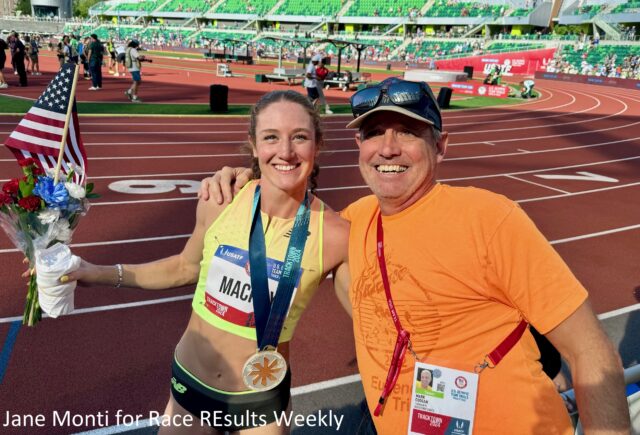
PHOTO: Emily Mackay and her coach Mark Coogan at the 2024 USA Olympic Track & Field Trials at Hayward Field at the University of Oregon in Eugene (photo by Jane Monti for Race Results Weekly)

Bor, D'Amato Claim USATF 20K Titles in New Haven
(c) 2024 Race Results Weekly, all rights reserved. Reposted with permission
NEW HAVEN (02-Sep) -- On a beautiful late summer day here in the Elm City, Hillary Bor (Hoka One One) and Keira D'Amato (Nike) scored convincing victories at the Faxon Law New Haven Road race which hosted the USATF 20K Championships. Bor, an Olympic steeplechaser, ran away from the field and won in a championships record 58:09. D'Amato, the former national record holder for the marathon, won in a more tactical effort, clocking 1:06:25, well off of her course and championships record of 1:04:29 set in 2022. Both athletes won $9,000 in prize money.
BOR IN A TIME TRIAL
Bor, 34, who lives and trains in Colorado Springs, took a clinical approach to today's race. Right from the gun he could be seen checking his watch frequently even after splitting a snappy 23:02 for the first five miles and 28:41 for 10K, about 18 seconds ahead of the chase pack. He had a plan.
"I wanted to test my fitness," Bor told reporters after the race. "I got accepted for Valencia Half-Marathon (October 27) and I know it's going to be really fast." He continued: "For me to go run the American record in Valencia Half (sub-59:47), also for me to run 59:30, I knew I needed to run at least 57-something in this course. That was the plan."
Bor took the lead in the first mile and recorded a 4:31 split. That was a little faster than he wanted.
"I just wanted to maintain about 4:35," he said.
Bor only had Kirubel Erassa for company in the first two miles, but by the three-mile mark (13:48) Erassa had to back off (he would later drop out). From there Bor just ran by time, cheered on at various points by handfuls of fans gathered on the course.
When he went into East Rock Park in the tenth mile he began to tire, despite hitting a fast split of 46:44.
"There was a lot of hills and I just got a little bit tired at the end," Bor lamented.
For the final 2.4 miles to the finish, Bor backed off his pace and was able to enjoy the cheers from the crowd which he acknowledged with friendly waves. His time of 58:09 surpassed Matt Tegenkamp's 2012 championships record of 58:30 (also set in New Haven), but did not approach Khalid Khannouchi's 1998 event record of 57:37. In all, Bor was pleased with his race.
"I'm excited, I'm excited," he said. "I have a 10K to test my speed in two weeks then Valencia."
Behind Bor the four-man chase pack of Nathan Martin, Biya Simbassa, Aidan Reed and Sam Chelanga hung together until about the final mile when the sprinting began. Martin, who had led the chase pack most of the race, got second in 58:26, three seconds ahead of Simbassa. Reed ran 58:31 and Chelanga clocked 58:39.
"The game plan was, hey, if I have a shot to win just to go for it," Martin told Race Results Weekly. "Hillary kind of took it out really strong (so) I wanted to be conservative and not make moves that would cost me later in the race." He continued: "Overall, a fantastic race. Really happy with it."
D'AMATO COMES DOWN FROM ALTITUDE
D'Amato, 39, came to New Haven after her first-ever training stint at high altitude in Park City, Utah, under Brigham Young University coach Ed Eyestone. She incorporated today's race into her build-up for the Bank of America Chicago Marathon on October 13, and decided to run a more moderate pace than when she set the course and championships record of 1:04:29 here in 2022.
"I tried to stay relaxed through half, and then squeeze it down a little bit," D'Amato explained to reporters. "I was really fortunate to have a very strong group of ladies to pull through."
At the 10-K mark (33:20) Annie Frisbie led D'Amato, Jess McClain, Savannah Berry and Mary Grace Hurley. By nine miles (48:21) D'Amato began to pull away.
"I was feeling really strong so when I got to the top of the hill (just before the 10-mile mark), knowing all the tangents through I figured I could pick up some speed and hopefully put on a little gap, and just hold strong for the rest."
Indeed, she did. D'Amato finished 25 seconds clear of McClain (1:06:50), with Berry (1:07:03), Frisbie (1:07:19) and Hurley (1:07:29) making up the rest of the top-five. D'Amato got emotional when she said how important this race was for her especially after failing to finish the USA Olympic Trials Marathon back in February.
"This has been a year for me," said D'Amato. "I've had a lot of lows, some changes, and I'm just so pumped to have a really strong, hard effort today. I feel like I'm moving in the right direction."
Coach Eyestone agreed.
"Obviously, this is just kind of a checkpoint in the build (for Chicago)," Eyestone told Race Results Weekly. "You come into this with some pretty heavy mileage. I think this was good. She said that she felt strong." He continued: "Coaches like it when it's not close at the end."
In all, 533 athletes finished the 20K while another 1142 finished the companion half-marathon, and 2459 finished the 5K.
PHOTO: Hillary Bor wins the 2024 USATF 20-K Championships at the Faxon Law New Haven Road Race (photo by Jane Monti for Race Results Weekly)

Key Takeaways from Running USA's Race Participation Growth Webinar
Following the release of a new Running USA industry insights report that shows significant growth for many running events in the first half of 2024, the organization held a webinar with four race production professionals to learn first-hand what they have experienced at their events.
The report (free to download for all active Running USA members) shows significant growth in race participation across various race distances. The growth ranges from 12.5% to 26%, with marathon finishers up by 26%. Individual races and race weekends (comprising multiple race distances) saw substantial increases, particularly 5Ks (19%), 10Ks (20%), half marathons (15.5%), and marathons (26%). These numbers are derived from finisher data through Athlinks, excluding no-shows.
Moderated by Running USA Executive Director Jay Holder, the participating panelists were:
● Dan Lakin, Sr. Event Operations Manager and Race Director, Ventures Endurance (Louisville Triple Crown of Running)
● Becky Radliff, Director of Marketing and Events, Eugene Marathon
● Ashlee Snider, Director of Marketing, Metropolitan Richmond Sports Backers (Ukrop’s Monument Avenue 10K)
● Mike Wattigny, Marketing & Creative Director, FRESHJUNKIE Racing (Louisiana Marathon)
Read on for more insights from the virtual session and watch the recording in its entirety here.
Meet the featured events
The Eugene Marathon experienced a 31% growth in participation across its half marathon and marathon distances (2023-2024). Becky Radliff attributes this to strong community engagement and successful virtual races during COVID.
The Louisville Triple Crown of Running reported a 28% total growth, with their 5K and 10K races seeing 31% increases and the 15K achieving a 25% increase.
The Louisiana Marathon saw a 28% growth in finishers. Mike Wattigny noted that industry-wide inertia, combined with the closure of other races, contributed to their leadership position in the region.
The Ukrop's Monument Avenue 10K in Richmond had 23% growth, with finishers increasing from 15,200 in 2023 to 18,732 in 2024. Ashlee Snider explained their focus on community and celebration to maintain engagement post-pandemic.
Post-pandemic return to racing and runner re-engagement
All of the speakers discussed the challenges and strategies of restoring participation after the pandemic. Becky Radliff (Eugene Marathon) mentioned their focus on a virtual race experience in 2021, which helped retain runners. Ashlee Sneder (Ukrop’s 10K) emphasized the importance of community and celebration to re-engage participants after a three-year hiatus.
Mike Wattigny highlighted several strategies FRESHJUNKIE has employed to connect with their audience post-pandemic. One key tactic was the launch of an ambassador program, which gained traction in response to decreasing returns from digital marketing efforts. By putting out a call to their runner database, they received over 100 applicants, resulting in a selection of "micro-influencers" who actively participated in local running clubs and events. The success of this program encouraged them to expand the ambassador team for the upcoming season, further enhancing community engagement.
Wattigny discussed compensating ambassadors with race entries, gear, and VIP access, tailoring incentives to encourage long-term commitment and participation. He acknowledged that while the ambassador program has yielded positive results, there is a learning curve in guiding influencers to maximize their social media impact. He plans to strengthen their communication and coaching efforts to drive even greater returns from their ambassadors in the future.
Dan Lakin talked about the importance of rebuilding trust within the running community after the challenges of the pandemic. His team took a hands-on approach, meeting with running clubs, reading past event surveys, and engaging with their community to better understand and cater to their needs. They also developed VIP programs and experiential enhancements, such as food and music, to elevate the participant experience and ensure future growth.
Curating a memorable event that generates a fear of missing out
Becky Radliff echoed similar sentiments on participant experience, stressing the importance of focusing on every interaction—from social media engagement to race day execution. Her team invested heavily in documenting race weekend through video and photography to boost organic reach, especially on Instagram Reels. She attributed much of the race's recent growth to these visuals and their consistent engagement on social media.
Wattigny agreed, saying that video, particularly vertical video on platforms like TikTok, plays a crucial role in showcasing the event's experience, helping to expand their reach beyond local participants.
Demographic trends reflected in participation increases
Snider (Ukrop’s Monument Avenue 10K): Demographics are skewing younger, with growth in the 18-29 age range (+4 percentage points from 2022 to 2024). Racial diversity is increasing as well, with rises in Black (+2%) and Hispanic participants, while White participants decreased (-3.5%).
Lakin (speaking about Chicago events): Similar trends, with growth in younger, more diverse groups due to partnerships with community groups like Black Girls Run and Latinas Run.
Wattigny: Marathon events seeing a slight increase in younger participants. The growth of female runners (60-65% in half marathons) and the importance of grassroots connections are emphasized.
Both Lakin and Snider noted that marketing efforts for shorter races like 5Ks and 10Ks tend to be more localized, targeting nearby runners and drive markets, while longer races, like half-marathons and marathons, tend to attract participants from farther afield. Snider mentioned that the Richmond 10K has benefited from outreach to local run clubs and attending expos in nearby cities, boosting awareness without heavy investment in paid advertising.
Marketing and budgeting strategies
Lakin: 8-10% of revenue goes toward marketing, with a $4-5 acquisition cost per participant for shorter distances.
Wattigny: Higher acquisition costs (~$10) for marathons, shifting back to grassroots tactics and reducing reliance on digital marketing due to changes in algorithms.
Forecasting growth was challenging. Radliff and Lakin discussed making real-time adjustments to procurement based on race growth, such as medals and participant caps.
Post-race and spectator experience
Snider: Ukrop’s Monument Avenue 10K is branded as Richmond's biggest block party, focusing on engaging spectators and volunteers to create a festive atmosphere.
Radliff: Post-race experiences for participants at Hayward Field are enhanced by opening the stadium for participants to relax, enjoy hot pancakes, beer, and watch the race.
Paid VIP post-race experiences were common across all events, offering exclusive access to food, drinks, and comfortable seating.
**
Looking for more insights? Watch the full recording and stay tuned for the release of the 2024 Global Runner Survey from Running USA.
Chef Yaku Moton-Spruill’s Emerging Leader Experience at the 2024 Running USA Industry Conference
Editor's note: The 2025 Emerging Leaders program is currently accepting applications. You can apply here.
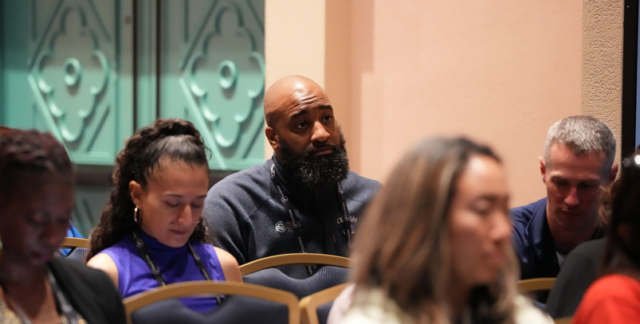
At the 2024 Running USA Industry Conference in Orlando, one of the most compelling newcomer stories came from Chef Yaku Moton-Spruill of Northern California. Chef Yaku found himself right in the heart of the running community, amidst like-minded industry professionals in a way he had never encountered before. As a member of the 2024 Emerging Leaders program, Chef Yaku's presence and insights offered a fresh perspective on the intersection of food and running. Hear him talk about his experience in a recent interview.
A Culinary Journey into Running
Chef Yaku’s journey into the running industry began with an unusual request. Originally a professional chef with a degree from culinary school in San Francisco and experiences on cooking reality TV shows to his credit, Yaku's entry into the running scene was serendipitous. His business partner was seeking a caterer for a grueling 24-hour trail event. Despite the daunting nature of the event, Yaku agreed to take on the challenge.
"I remember thinking, 'What am I getting into?' but I wanted to carve out a new niche for myself," Chef Yaku recalled. The experience was eye-opening. He was astounded by the passion of the runners who, despite enduring extreme physical challenges, returned from the trails covered in mud and smiles.
As Yaku observed and engaged with the running community, he found himself drawn to the camaraderie and spirit of the sport, especially its ability to bond complete strangers as newfound friends. Although he was initially skeptical about running itself, the community’s warmth and the shared experiences left a lasting impression on him.
The Impact of the 2024 Conference
Though he initially wasn’t sure what to expect, attending the 2024 Industry Conference influenced Chef Yaku in many ways. The conference provided him with a platform to share his unique perspective on how culinary expertise can improve and elevate events. His breakout session was a hit, drawing a standing room only crowd who were eager to learn how to elevate food offerings at running events.
"The conference was incredible," Yaku said. "Being surrounded by like-minded individuals who share a passion for running, regardless of their background, was deeply inspiring. We were all runners first, and that common ground made it easy to connect."
For Chef Yaku, the most valuable aspect of the conference was the sense of community and the exchange of ideas. He appreciated how the race directors and other industry professionals in attendance, regardless of their experience level, supported each other and shared insights openly.
Advice for Future Emerging Leaders
When asked if he would recommend the Emerging Leaders program to others, Chef Yaku's response was enthusiastic. "Absolutely, do it without hesitation. The program offers incredible opportunities to learn and grow, whether you’re a novice or experienced in the field."
He emphasized the importance of approaching the conference with an open mind and a willingness to absorb new information. For him, the experience was transformative, helping him to expand his horizons beyond the culinary world.
The conference not only offered Chef Yaku professional growth but also fostered lasting connections. He has continued to engage with many of the people he met, collaborating on events and projects across the country.
"I’m excited about the opportunities that have come from this conference," Chef Yaku shared. "From catering for trail series in Utah to helping out with marathons, it’s been a fantastic journey. The connections I’ve made have opened new doors for me."
Chef Yaku Moton-Spruill’s experience at the 2024 Running USA Industry Conference is a testament to the power of interdisciplinary engagement. His journey from the kitchen to the running world illustrates how passion and expertise can intersect to create meaningful impact.
For anyone attending future conferences, Chef Yaku’s advice is clear: be a sponge, absorb everything, and embrace the sense of community. The Running USA conference is not just an event but a vibrant ecosystem where runners and professionals alike can come together, share knowledge, and inspire each other.

With Marathon Win, Hassan Nabs Historic Third Paris 2024 Medal
(c) 2024 Race Results Weekly, all rights reserved. Reprinted with permission.
(11-Aug): The athletics program at the 2024 Olympics concluded in spectacular fashion on Sunday, with Sifan Hassan of the Netherlands winning the women’s marathon in a sprint finish to take her third medal at the Paris Games. World record holder Tigst Assefa of Ethiopia crossed the line three seconds behind, and Kenya's Hellen Obiri completed the podium. Hassan became the only woman in history to win medals in the 5000m (bronze), 10,000m (bronze) and marathon (gold) in the same Olympic Games.
As with the men's race on Saturday, the women were cautious in the early going, acutely aware that several brutal hills awaited them mid-race, as well as a temperature that would be steadily rising from the 66F/19C at the start. There was no cloud cover and the course has little shade.
The field of 91 athletes set off from Hôtel de Ville (the Paris city hall), but the first casualty would come quickly. U.S. Olympic Trials champion Fiona O'Keeffe, who was running awkwardly from the start, dropped out before the 5-K mark. She would be among 11 athletes who did not finish the race.
A crowded lead pack went through 5K in 17:24, and then picked up the pace slightly to hit 10-K in 34:32. By 15K (51:12) there were 14 women up front, including defending Olympic champion Peres Jepchirchir of Kenya, Assefa (who set the world record of 2:11:23 at the 2023 Berlin Marathon), Obiri (a two-time Olympic silver medalist in the 5000 meters and a world champion in indoor and outdoor track and cross country) and France's Melody Julien, who remained at or near the lead through most of the first half.
The initial hilly portion of the course, which began at 15K, slowed the pace significantly, allowing several women to catch up to the leaders, including Dakotah Lindwurm of the U.S. and Japan's Yuka Suzuki. Suzuki, 24, the Japanese Olympic trials winner last October, hoped to break Japan's 20 medal drought in the Olympic Marathon.
By halfway (1:13:22) there were 20 women in contact, and moments later Lindwurm made a bold move to the front, leading the race at the turnaround point at Versailles.
"I looked up and said, 'God, you're crazy.' I can't believe he put me in that position," Lindwurm told NBC Sports' sideline reporter Steve Porino just after the race. "I've got so many people back in Minnesota watching me, that I could almost feel Minnesota watching me. It was an honor to be around those women."
The decisive racing took shape during the relentless 600-meter stretch of hills after 28K, which rose at a 10.5% grade. Assefa, fellow Ethiopian Amane Beriso Shankule, Kenya's Sharon Lokedi, Jepchirchir and Suzuki separated from the field. Obiri briefly fell back but soon regained contact.
After cresting the hill at 30K (1:43:59), nine women were back in contention on a harrowing downhill section, including Hassan, Suzuki, Bahrain's Eunice Chumba and Romania's Delvine Meringor. The pace quickened and by 35-K (1:59:43) the leaders had recorded their fastest 5K split of the day (15:44). Soon Chumba, Meringor and Jepchirchir started to lose contact, followed by Suzuki (the Japanese medal drought would continue).
Approaching the Eiffel Tower in the 39th kilometer five contenders remained --Assefa, Beriso Shankule, Obiri, Lokedi and Hassan-- who strategically remained at the back of the group at all times.
Those five were still together at 40K (2:16:09), but a kilometer later Beriso Shankule fell behind, followed by Lokedi. Assefa and Obiri ran stride for stride, with Hassan right on their heels. Finally, with less than 400 meters to go, Assefa sprinted to the front. Hassan quickly responded, but Obiri (who said she missed two water stations earlier in the race and even stopped briefly to throw up) could not match the increased tempo.
As Assefa and Hassan rounded the final curve heading onto the bright blue carpet at the Esplanade des Invalides, they briefly tangled. (Though the contact seemed incidental, the Ethiopian federation filed a request to have Hassan disqualified; it was rejected by the jury of appeal.) Hassan maintained her poise, surged ahead, but continued to look back even as it was clear Assefa could not match her kick.
"At the end I thought, 'This is just a 100m sprint. Come on, Sifan. One more,'" she said.
The indefatigable Dutchwoman hit the tape in 2:22:55, breaking the Olympic record set by Ethiopia's Tiki Gelana 12 years ago in London (2:23:07). Assefa finished in 2:22:58 for the silver medal, while Obiri (2:23:10) took the bronze, just ahead of Lokedi (2:23:14). Beriso Shankule (2:23:57), Suzuki (2:24:02) and Meringor (2:24:56) followed, while Jepchirchir (2:26:51) faded to 15th.
Lindwurm (2:26:44) was the top American, in 12th place, while countrywoman Emily Sisson (2:29:53) finished 23rd. "I'm happy to be here for sure," Lindwurm told Race Results Weekly. "It was super-fun. I was trying to black out as much as possible, do as little thinking as possible. But I was also trying to soak in some moments. It was so cool, the entire way I feel like I was hearing, 'USA, USA.'"
This was the sixth Olympic medal of Hassan's career. Three years ago in Tokyo she won gold in the 5000 and 10,000 meters, along with a bronze in the 1500. She tackled an even more ambitious schedule in Paris, covering more than 62 kilometers/38 miles over 10 days, taking bronzes in both the 5000 on August 5 and the 10,000 on August 9, a day and a half before the marathon.
"Every moment in the race I was regretting that I ran the 5000 and 10,000," the 31-year-old Hassan admitted. "I was telling myself if I hadn't done that, I would feel great today. From the beginning to the end, it was so hard."
She said that she didn't feel comfortable until after the 20K mark.
"Then I knew I wanted gold," she said. "But everybody else was fresh and all I was thinking was, 'When are they going to break? They're going to go hard, they're going to go hard.'"
Hassan has established herself as the most versatile runner of her generation, with personal bests ranging from 1:56.81 in the 800 meters to 2:13:44 in the marathon, her winning time in Chicago last fall. She has held world records in the mile and 10,000 meters and won a world title in the 1500. Still, this was a humbling moment.
"I have so many emotions," she said. "Every step I challenged myself, and now I am so grateful I didn't push myself too much on the track. I was scared of this race. I am Olympic champion. What can I say?"
PHOTO: Sifan Hassan of the Netherlands winning the 2024 Women's Olympic Marathon in Paris in a Games record of 2:22:55 (photo by Jane Monti for Race Results Weekly)