Article
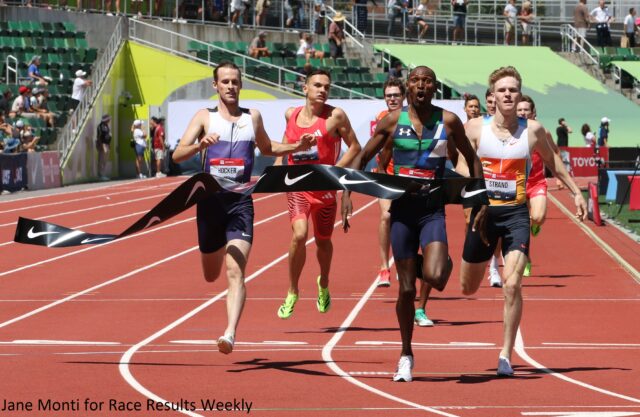
Hiltz, Koech Take USA 1500m Titles
(c) 2025 Race Results Weekly, all rights reserved. Published with permission.
EUGENE (02-Aug) -- On the penultimate day of the 2025 Toyota USATF Outdoor Track & Field Championships at Hayward Field at the University of Oregon, Nikki Hiltz and Jonah Koech won ultra-competitive 1500m finals with sizzling kicks. Hiltz, 30, a former Arkansas Razorback, won their third straight title in 4:03.15, winning a two-up sprint against Sinclaire Johnson. Koech, 28, was an upset winner in a championships record and personal best 3:30.17. He beat both Olympic medalists in the race, Cole Hocker (who finished third) and Yared Nuguse (who was fifth). Both Hiltz and Koech locked-in team berths for the World Athletics Championships in Tokyo next month.
Hiltz Wins Again
Hiltz, who finished seventh in the Paris Olympics in 2024, saw the race set up exactly as they like. Hiltz was happy to have Laurie Barton take the field through the first 400m in a gentle 67.9 seconds, and Hiltz was tucked in third position with key rival Johnson one place ahead. With Barton still on the front, Hiltz stayed in the front-third of the pack through 800m (2:15.9) and knew that the pace would heat up soon.
"I knew it was going to be, like, a really fast last four (hundred meters)," Hiltz told reporters. "It was going to come down to positioning. I just got a good position."
Johnson came to the front at the bell, and Hiltz, Emily Mackay, Heather MacLean and Dani Jones all reacted. Johnson led through 1200m with a 63.9-second lap with Mackay and Hiltz close behind. Johnson knew she needed to keep the pace high to take away some of Hiltz's advantage in closing speed.
"I figured it was going to be more (a) sit and kick race," Johnson told reporters. "Just wanted to stay out of trouble and be ready for any moves."
Johnson led Hiltz around the final bend, then the defending champion shifted into high gear. Hiltz passed Johnson to win by 62/100ths of a second, 4:03.15 to 4:03.77. Mackay was a clear third in 4:04.38 more than a second ahead of her former training partner Heather MacLean (4:05.60). Jones finished fifth in 4:05.62, her highest placing at a national outdoor championships.
"I knew we were going to go hard on the backstretch," said Hiltz. "Sinclaire definitely pushed it. I just told myself, be patient, be patient, be patient. Then with 150 to go that's where my coach was like, with 150 to go you can let it rip. I was kind of holding back until then."
Johnson, who made the World Athletics Championships teams for both 2022 and 2023 but finished fourth at last summer's Olympic Trials, was very pleased to make another national team, her second this year (she finished sixth in the World Athletics Indoor Championships in the 1500m last March).
"My main goal was to win today," said Johnson, who is coached by her fiancé fiance Craig Nowak. "I felt like I did the best that I could to hold Nikki off, especially on that backstretch." She continued: "I'm really stoked with it. The goal was always to get to Tokyo."
Koech Upsets Olympic Medalists
The men's 1500m figured to be a rematch between the Olympic medalists Hocker (gold) and Nuguse (bronze), and the race began with Nuguse controlling the pace from the front. The American record holder for the mile went to the front early in the first lap and took the field through 400 meters in an honest 56.3 seconds. Then with laps of 58.4 and 56.0 Nuguse stayed on the front through 1200 meters. That was his plan, he said.
"I ran it how I wanted to," said Nuguse. "Going out there, grinding it. I've done it before. I felt confident doing it again."
With 200 meters to go, Nuguse still had the lead. Lined up behind him were 2024 Olympian Hobbs Kessler, Hocker, and 3:48 miler Ethan Strand, who just finished his NCAA career at the University of North Carolina. Koech was only in sixth position, but was coming fast.
"If it was slow or faster I was ready for that because I trained for that," Koech said. "I was trying to everything, whatever was needed, to be up with these guys." He added: "It was my day."
Koech, who was only in seventh place with a lap to go, blazed a 52.91-second final lap, and moved from third to first in the final 100m. Nuguse struggled in the final 50 meters and would finish fifth, but Strand had the race of his life. He held off the final charge from Hocker to finish second in a personal best 3:30.25. Hocker got third in 3:30.37, and Kessler was fourth in 3:31.12.
"Maybe went a little too early, but I'm strong enough right now to get to the finish line in the top three," said Strand, whose father Scott was a four-minute miler. "I definitely went for the win."
Rooks and Halladay-Lowry Take Steeplechase Titles
In the two other distance finals today Kenneth Rooks and Lexy Halladay-Lowry, who are both from Utah and both went to Brigham Young University, won the 3000m steeplechase titles. Rooks, 25, the 2024 Olympic silver medalist, controlled the race from the halfway point, squeezing down the laps until he ran the final circuit in 59.1 seconds. He managed to hold of a hard-charging Daniel Michalski --who trains with Rooks under coach Ed Eyestone-- to win in 8:26.58 to Michalski's 8:26.77. Benard Keter got third in 8:29.00, beating 2024 Olympian Matthew Wilkinson by 32/100ths of a second.
"It was slow, so I just stayed relaxed as long as I could," Rooks said. "I realized that nobody was going to start squeezing it down so I started squeezing it down, spreading it out a little bit towards the end, and I had the finish to get the win."
Michalski's second place finish was a surprise. Five men came into the race with the World Championships entry standard of 8:15 under their belts, but Michalski was not one of them. But Michalski, who is part of the U.S. Air Force World Class Athlete Program, had run 8:18.40 last month and trusted his training.
"I'm just kind of flabbergasted," Michalski told reporters, wearing a cowboy hat. "I'm trying to have fun with this and I'm just so grateful for Air Force WCAP for supporting me and this lifestyle I get to have as a professional athlete with an active service time."
Halladay-Lowry, who just finished her NCAA career at BYU, allowed 2024 Olympian Courtney Wayment to lead the first four laps and tried to remain patient. She had worked out a hand signal system with her coach, Diljeet Taylor, who would hold her hands like two pistols when it was time to go. Taylor flashed the signs just before the bell, and Halladay-Lowry surged ahead.
"When she gave me the guns then I could go," said Halladay-Lowry, holding her hands like pistols. "When I saw that, I took it and didn't look back."
Halladay-Lowry ran a fast 9:09.14 to take the win. Behind her, North Carolina State's Angelina Napoleon was chasing hard and held second position to the line. Kaylee Mitchell, who went to Oregon State University and now lives in Eugene, got third in 9:11.36, barely holding off Krissy Gear, who ran a personal best 9:11.64.
Napoleon is only 20 and just finished her sophomore year at NC State. Hailing from the Upstate, N.Y., village of Allegany (population 1773), her best steeplechase time last year was only 9:54.08. Now she's headed to the World Athletics Championships.
"Absolutely insane," said Napoleon when asked how it felt to make a national team. She added: "Just being here was such an experience. Like I said on Thursday (after the prelims) I think that it is anybody's game. I think that the people that made it really showed that. It's a young field going (to Tokyo)."
Indeed, all three Paris 2024 Olympians --Val Constien, Courtney Wayment and Marisa Howard-- will not be on the team. Constien, the defending champion, finished seventh today; Wayment was sixth; and Howard did not compete. Gabbi Jennings, who was having an excellent year with a season's best of 9:06.61, only finished ninth.
"You can't forget about the women who really paved the way for us in steeple," Napoleon added. "That was one of the most insane races I've ever been in in my life."
PHOTO: Lexy Halladay-Lowry winning the women's 3000m steeplechase at the 2025 Toyota USATF Outdoor Track & Field Championships in Eugene, Oregon (Photo by Jane Monti for Race Results Weekly)
- - - - - - -
The 2025 Toyota USATF Outdoor Track & Field Championships continue tomorrow at Hayward Field with finals in the men's and women's 800m and 5000m.
PHOTO (top): Jonah Koech winning the men's 1500m at the 2025 Toyota USATF Outdoor Track & Field Championships in Eugene, Oregon (Photo by Jane Monti for Race Results Weekly)
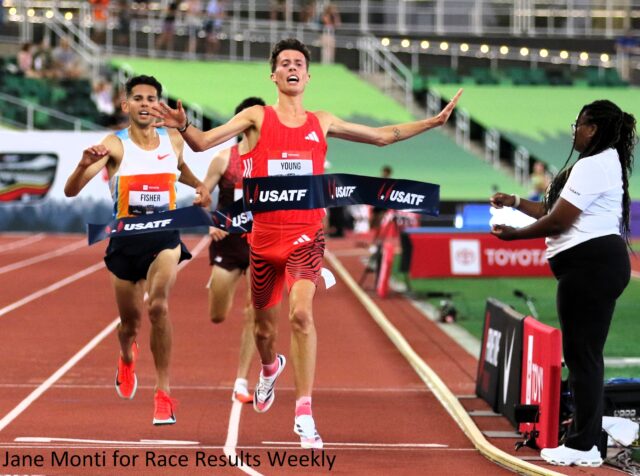
Infeld, Young Take National 10,000m Titles At Toyota USATF Championships
(c) 2025 Race Results Weekly, all rights reserved. Published with permission.
EUGENE (31-Jul) -- On the opening day of the 2025 Toyota USATF Outdoor Track & Field Championships at Hayward Field at the University of Oregon, Emily Infeld and Nico Young won the women's and men's 10,000m, respectively, each earning their first national track titles. Infeld, 35, who nearly ten years ago won the bronze medal in the same discipline at the World Athletics Championships in Beijing, prevailed in a last lap, four-way battle over Elise Cranny, Taylor Roe and Weini Kelati. Young, 23, beat defending champion Grant Fisher in a two-up sprint in the homestretch, edging the double Olympic bronze medalist by just 25/100ths of a second.
Infeld Bides Her Time
Infeld came into tonight's race feeling strong and confident. After spending 12 years as a Nike-sponsored, she picked up an unexpected sponsorship with Brooks in January, and felt a new motivation to train.
"I think especially after my last two years, a lot of people are probably like, she's on the downhill," Infeld admitted. She continued: "They (Brooks) believed in me and didn't want me to move up to the roads."
Tonight she patiently followed Cranny, a two-time Olympian and 2023 national 10,000m champion, who set the early pace. Cranny ran the first half of the race gently, splitting 5000m in 16:21.52. That left eight women still in contention: Cranny, Infeld, Taylor Roe, Weini Kelati, Jessica McClain, Karissa Schweizer, Keira D'Amato, and Amanda Vestri. Infeld was ready for whatever might happen.
"I knew I was in good shape, and I was just biding my time," Infeld told reporters. She continued: "I was like, I'm just going to try to be there, I'm going to try to follow any moves."
It wasn't until the eighth kilometer that the race broke up. Cranny dropped a 71.4-second lap, and the race quickly came down to four: Cranny, Infeld, Roe and Kelati. Roe made the next move, taking the lead through 8 km, but the pace remained stable and the four women remained together. On the final lap, Cranny surged on the backstretch, dropping Roe and Kelati, but Infeld was able to hang on. The two women rounded the final bend together and Infeld pulled away down the homestretch on the strength of a 65.6-second final lap. Cranny came in second and Roe beat Kelati in the final sprint to take third.
"I can't believe it!" Infeld said. "I'm so happy!"
Infeld (31:43.56), Cranny (31:44.24) and Roe (31:45.41) earned provisional spots on the United States team for the World Athletics Championships in Tokyo in September. But since none of them have achieved the entry standard of 30:20.00, they have to hope they can gain entry via their world rankings positions (or, less likely, run the entry standard by August 24). As it stands now they are well outside of the quota in the official World Athletics Road To Tokyo listing, while Kelati and Karissa Schweizer, who finished sixth, are inside the quota.
Back in seventh place, the 40 year-old D'Amato set a new national masters record of 32:19.40. She used tonight's race as part of her build-up for a fall marathon.
Young Gets the Best of Fisher
In the men's race the early pace was painfully slow. The athletes ran laps as pokey as 75.4 seconds, and the halfway split was reached in a tepid 14:54.58. The key contenders --Young, Fisher, Graham Blanks and Woody Kincaid-- were fine with that as all of them have strong kicks and all possessed the World Championships entry standard of 27:00.00. Kincaid, who would finish eighth, expected the slow pace.
"That's how he races," Kincaid said of Fisher, the defending champion. "That was kind of his rehearsal in Grand Slam this year (where he won in sprint finishes). So, I thought he might do that."
Fisher waited until four laps to go before dropping the hammer. He ran a 60.2-second lap through 8800m, then 59.4 through 9200m. That gave Fisher, Young and Blanks a two-second gap over their nearest chaser, Ahmed Muhumed.
On the final lap Young went ahead of Fisher on the backstretch. Blanks tried to pass him too, but Fisher and Young pulled away, leaving Blanks to finish third. Down the homestretch, Young was able to out-leg Fisher, running 56.6 seconds for the final lap to Fisher's 57.4. The top three clocked 29:02.12, 29:02.37 and 29:03.66, respectively. Young's winning time was the slowest at these championships since 1998.
"Once the pace started speeding up I knew I had to match the move as long as I could," Young explained. "That's honestly all I was thinking for those last four laps until I moved."
Fisher said that he didn't quite feel the snap he expected in his legs during the final sprint.
"I wanted that win pretty bad," Fisher said. "Didn't quite have the legs in the last 100 meters. That's the way it goes sometimes. Bounce back again for the 5K."
Plenty of Qualifying Action in the 800m, 1500m and 3000m Steeplechase
The first of three rounds of the 800m for both men and women were also held today. On the men's side, seven-time national champion Bryce Hoppel led all qualifiers with a mark of 1:45.69 achieved in the first of four heats. Hoppel, 27, said that he was a little surprised that he needed to run that fast.
"It was great," Hoppel told a group of reporters. "It definitely got out a little faster than I prefer but, you know, we're ready for whatever."
Also advancing to the semi-finals was reigning world indoor champion Josh Hoey. The 25 year-old won the third heat unpressed in 1:47.14 (his brother Jonah finished fifth and also advanced).
"What a long journey to get here," said Hoey, who has a season's and personal best of 1:42.01. "It's had some ups and downs, but this season's been good and we're just trying to continue to build up, try to get a PB, try to make the team."
Donavan Brazier, the 2019 world 800m champion who spent most of the last three years sidelined with injuries, advanced easily, literally jogging over the finish line in the fourth and final heat in 1:48.23. He was clearly grateful to be running again at a high level.
"I'm just trying to really enjoy it," said the smiling Brazier. "When you lose something and get it back you really appreciate it."
On the women's side, Sage Hurta-Klecker recorded the only sub-2:00 mark, winning the third of four heats in 1:59.28. Hurta-Klecker, who finished fifth here in the Olympic Trials last year and fell and broke her wrist in the 2021 Trials, was relieved to get through to the next round with no drama.
"After what happened last year I feel like nothing can faze me," said Hurta-Klecker, who added that her training was going well. "I've had three good low-volume weeks and that's what my body responds to."
Athing Mu-Nikolayev --the Tokyo 2020 Olympic champion who failed to make the 2024 Paris Olympics after falling at the Trials-- won the second heat with relative ease in 2:00.06.
"It was a pretty good heat," said Mu-Nikolayev who has slowly been regaining her form. "I think we got out like I kind of anticipated. I'm glad it was a little bit faster rather than it being slower. I think it just felt really good."
Hocker, Nuguse and Hiltz Advance in the 1500M
In the first of two rounds in the 1500m both 2024 Olympic medalists, Cole Hocker and Yared Nuguse, advanced with fast times. Hocker won the second of three heats in 3:32.57, while Nuguse ran a similar time of 3:32.66 to win the third heat. Ethan Strand won the first heat in 3:34.12, easing past 2024 Olympian Hobbs Kessler just before the line.
"I have too much experience to let anything come to chance, and I'm the Olympic champion so there's no reason for me to sit around out there," Hocker told reporters. "Just run my tempo today; that's what I did. Making this team does not get any easier."
The women's heats went more slowly, with Emily Mackay running the fastest time of 4:04.23. All of the athletes with the World Athletics Championships entry standard of 4:01.50 --Mackay, Nikki Hiltz, Heather MacLean, Sinclaire Johnson, and Helen Schlachtenhaufen-- advanced to the final. Hiltz, 30, is the event's defending champion.
"It's always nice to shake the legs out, get round one over with," Hiltz said. "Yeah, it was heat one, which is nice. "You kind of get it done. All good things; happy with my last 300 and happy to make another U.S. final."
Favorites Advance in the Steeplechase
In the first rounds of the steeplechase for both men and women all of the favorites advanced. On the women's side, Lexy Halladay-Lowry won the first heat in 9:37.53, followed by Olympian Val Constien in 9:37.56 and Kaylee Mitchell in 9:37.74. In the second heat North Carolina State's Angelina Napoleon edged Gabbi Jennings, 9:30.44 to 9:30.48. Olivia Markezich (9:30.49) and Olympian Courtney Wayment (9:30.70) finished third and fourth, respectively and also advanced to the final.
Jennings, who has lowered her personal best to 9:06.61 this season, hopes to improve on her fourth place finish at the Olympic Trials last year. She is coached by Joe Bosshard and trains with ten-time national champion Emma Coburn, Bosshard's wife. Coburn, who is sidelined with a hamstring injury, sat in the stands today to support Jennings.
"I think just dialing-in on the small things in training," said Jennings when asked about how she had improved so much this year. "I think that this gives me a lot of confidence and belief in myself. I do think I surround myself with incredible people who believe in you. It's important to believe in yourself, but it's certainly helpful when there's a large, very professional group of people who also believe in you."
Olympic silver medalist Kenneth Rooks led all qualifiers in the men's steeplechase, winning the second of two heats in 8:21.35. The other five athletes with the World Championships entry standard of 8:15.00 --Duncan Hamilton, Matthew Wilkinson, Isaac Updike, Nathan Mountain and James Corrigan-- also advanced.
"It felt like a solid day; it felt like a good prelim," Rooks told Race Results Weekly. "I've got some more left in the legs. It was a steady, constant effort, squeeze, and it ended the way I wanted it to." He added: "Being silver medalist adds to the pressure a little bit, but that's not an accomplishment I want to avoid. I want to embrace it."
**
The Toyota USATF Outdoor Track & Field Championships continue here tomorrow. The only middle or long distance events on tap are the men's and women's 800m semi-finals.
PHOTO: Nico Young winning the 10,000m at the 2025 Toyota USATF Outdoor Track & Field Championships (photo by Jane Monti for Race Results Weekly)
Historic Men's 5000m On Tap At USATF Championships
(c) 2025 Race Results Weekly, all rights reserved. Published with permission.
EUGENE (30-Jul) -- While American middle distance running has garnered a lot of attention over the last two seasons punctuated by a gold medal and Olympic record for Cole Hocker at the 2024 Paris Olympics in the 1500m, athletes in the 5000m have this season brought the longer event to a new zenith. So far this year five American men --Grant Fisher, Nico Young, Graham Blanks, Cooper Teare, and Cole Hocker-- have broken 13 minutes. Five of the six-fastest USA marks in history have been set this year, and Fisher (12:44.09) and Young (12:45.27) have run national records indoors and outdoors, respectively (Fisher has the absolute record).
"The sport, especially in the U.S., has grown leaps and bounds in the last decade or so," Fisher told reporters here at a press conference in advance of the four-day Toyota USATF Outdoor Track & Field Championships at Hayward Field at the University of Oregon. "You look at the all-time marks now. We've had three guys break 12:50 in one year, whereas in the past you might have one guy that would break 13:00 every other year. The depth is increasing a ton."
That depth will be on full display on Sunday afternoon when approximately 25 men will line up for a straight final in which the top three will provisionally qualify for the World Athletics Championships in Tokyo in September. At last year's Olympic Trials, also held here in Eugene, a field of 30 athletes was first narrowed down to 16 through two preliminary heats. This year's race will more closely resemble a mass-start road race rather than a small, super-elite final.
"It gets harder and harder every year," continued Fisher, who won the national 5000m title in both 2024 and 2022 and finished second in 2021. "There's really stiff competition. Guys that are younger and younger are training harder and harder, and that is producing way more depth at younger ages. We have a really competitive 5-K team."
Fisher, 28, who won bronze medals at the 2024 Paris Olympics in both the 5000m and 10,000m, is the oldest among the top contenders by at least three years. Blanks and Young are both 23, Hocker is 24, and Teare is 25. Fisher is also the only man among the top entrants who will also contest the 10,000m on Thursday (where he is also the defending champion) before running the 5000m on Sunday.
"My focus right now is the 10K; that's tomorrow," Fisher told reporters. "The 10K's first. Again, very stiff competition. It doesn't have quite the same depth at the 5-K, but still a very, very competitive field, several sub-27:00 guys. You look back to ten years ago you've got one guy, maybe, that breaks 27 minutes."
While there is no way to predict how Sunday's race will go, it's likely to be tactical. According to World Athletics, only Fisher, Young, Blanks, Teare and Hocker have achieved the 13:01.00 entry standard for the World Championships. None of those men will want to push the pace and can focus exclusively on their finish place (the championships record is 13:08.85 by Fisher from 2024). All of them are strong kickers, especially Hocker, who ran his final 300 meters in the Paris 1500m Olympic final in a sizzling 39.6 seconds. LetsRun.com's Jonathan Gault described that performance as "one of the greatest closes the sport has ever seen."
Fisher also has wheels, and recently ran a lifetime best of 3:48.29 for the mile at the Prefontaine Classic here in Eugene on July 5th. If anyone beats him on Sunday, that will be an upset, although he acknowledged that both Blanks and Young are formidable competitors at just 23 years-old.
"When you look at what Nico and Graham did in college, now that they have made it in the pro ranks you look back like, oh that makes sense," said Fisher, when asked to assess the development of his younger rivals. "Sometimes there are people who do really well at certain stages, but it doesn't always translate (later). Those guys are mega-talented, the times and performances they were able to do in college (were amazing). When I was in college nobody was doing anything remotely close to that."
Fisher said that he was in good shape and had tapered for these championships under coach Mike Scannell.
"I've been really intentional about when I'm pushing and when I'm not pushing in training," said Fisher, who said that he has to save energy and fitness for the World Championships. "Little bit of a taper going into this week which feels good because I've been training hard the past month. So, the early part of my season was defined by indoors, then after that I was locked-in to Grand Slam. Took a little bit of downtime. Now it's been a really, really solid build-up to now."
Fisher was also asked whether he had been paid the $200,000 in prize money he is owed by Grand Slam Track for winning the long distance group titles in both the Kingston, Jamaica, and Miami meets. Meeting organizers said that they planned to pay the Kingston prize money by July 31. Fisher said he hasn't seen that money yet.
"Tomorrow is the last day of July, so they do have a day," Fisher said. "The last update I heard was that by the end of July they wanted Kingston prize money out. It has not hit my bank account, or any else's that I know. So, fingers crossed, but tomorrow would be the last day or, I think, people will be pretty upset."
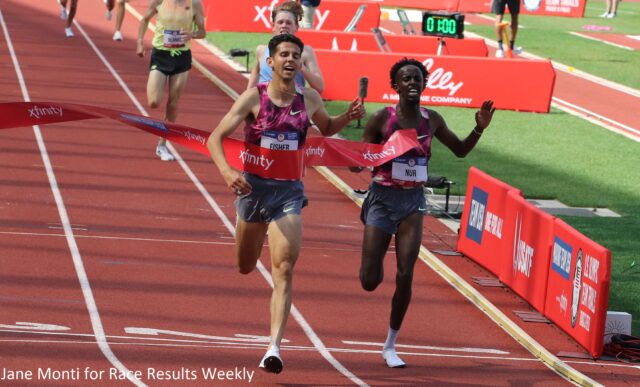
PHOTO: Grant Fisher winning the 5000m at the 2024 USA Olympic Team Trials over Abdihamid Nur (photo by Jane Monti for Race Results Weekly)
World Record Holder Ruth Chepngetich Provisionally Suspended
(c) 2025 Race Results Weekly, all rights reserved. Published with permission.
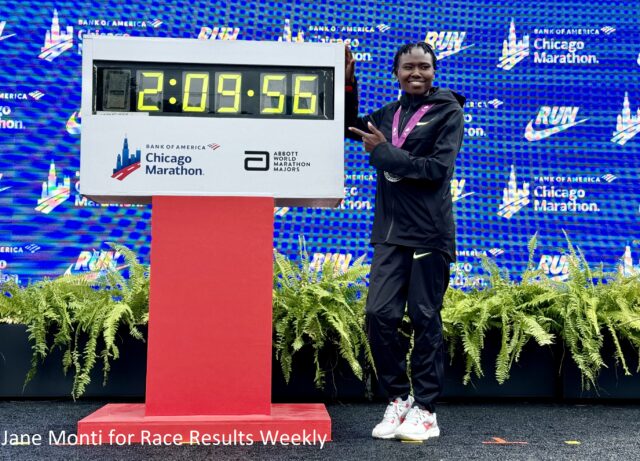
(17-Jul) -- Ruth Chepngetich, the 2019 World Athletics Championships marathon gold medalist who ran a world record 2:09:56 at the Bank of America Chicago Marathon last October, has been provisionally suspended by the Athletics Integrity Unit (AIU) for a doping infraction. The 30 year-old Kenyan tested positive for Hydrochlorothiazide (HCTZ), a diuretic, in a urine sample collected from her on March 14 of this year.
Under AIU procedures, the athlete was issued a Notice of Charge after an investigation was launched. Chepngetich was interviewed by AIU investigators in Nairobi on April 16 and "complied with requests regarding our investigation," according to AIU chief Brett Clothier.
"When there is a positive test for diuretics and masking agents, a provisional suspension is not mandatory under the World Anti-Doping Code," Clothier explained through a press release. "Chepngetich was not provisionally suspended by the AIU at the time of notification. However, on 19 April, she opted for a voluntary provisional suspension while the AIU's investigation was ongoing." Clothier continued: "In the intervening months, the AIU continued its investigation and today issued a Notice of Charge and imposed its own provisional suspension."
The AIU said that they would have no further comment on the case until it reached its conclusion. A diuretic does not increase performance per se, but can mask the presence of other drugs. Hydrochlorothiazide, and other diuretics, are "banned at all times," according to the World Anti-Doping Agency.
An HCTZ reading of 20 nanograms per milliliter in urine would be considered a negative result, but Chepngetich tested at a far higher level: 3800 ng/mL.
Although Chepngetich's world record in Chicago was ratified by World Athletics, the mark was looked upon with doubt by at least some experts. She slashed the previous world record by a hefty one minute and 57 seconds, and would have finished 11th in the men's race. She ran the first half in 1:04:16, and her halfway split was the fastest-ever half-marathon run in the United States by a woman.
Former Runners' World editor and 1968 Boston Marathon champion Amby Burfoot was openly skeptical of Chepngetich's performance. Writing for marathonhandbook.com, Burfoot wrote: "Chepngetich's performance is only about 7.75% slower than Kelvin Kiptum's men's marathon world record. It should be 10 to 11% slower, like all the other male-female differentials in the running record books. There's a massive amount of data behind these percentages, and historically any small variation amounts to a highly suspect performance."
During the post-race press conference in Chicago, Robert Johnson of Letsrun.com asked Chepngetich how her then-pending record should be viewed given the dozens of doping violations recorded by the AIU for Kenyan athletes in recent years. Johnson said: "What would you say to someone that, when they see 2:09:56, say this is too good to be true?" Chepngetich hesitated before saying she didn't know. Johnson was criticized by Kenyan officials, including some in the Kenyan National Assembly, who saw his question as insulting.
Seven Kenyan athletes received doping sanctions in June, and there are currently 139 Kenyan athletes serving doping bans, the most of any country.
Chepngetich has only competed once since her Chicago run. She took second at the Lisbon Half-Marathon on March 9. She was supposed to compete in the TCS London Marathon on April 27, but withdrew prior to the race.
"I'm not in the right place mentally or physically to race my best in London and I am therefore withdrawing," Chepngetich said through a statement provided by London Marathon Events. "I am very sad to miss the race and I hope to be back next year."
PHOTO: Ruth Chepngetich after setting her marathon world record at the Bank of America Chicago Marathon on October 13, 2024 (photo by Jane Monti for Race Results Weekly)
Chebet, Kipyegon Dazzle With World Records At Prefontaine Classic
(c) 2025 Race Results Weekly, all rights reserved. Published with permission.
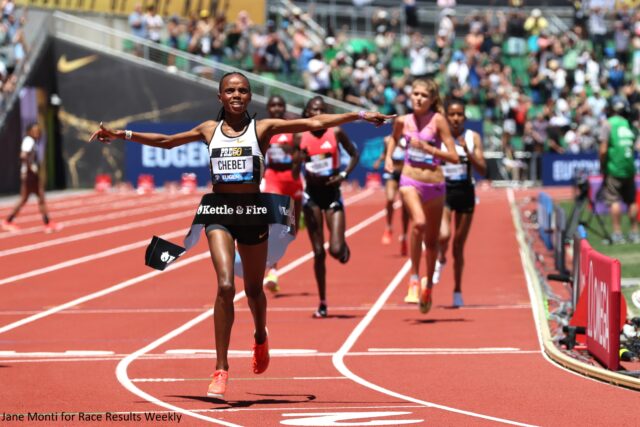
EUGENE (05-Jul) -- The gala 50th edition of the Prefontaine Classic lived up to all the hype, punctuated by world record performances by Kenyans Beatrice Chebet and Faith Kipyegon. Chebet, 25, became the first woman in history to break 14 minutes for 5000m, clocking 13:58.06 in a race which also served as the Kenyan Trial for the 2025 World Athletics Championships in Tokyo in September. Kipyegon, 31, rebounded strongly from her attempt to break four minutes for the mile in Paris just over a week ago and ran 3:48.68 for 1500m, the first ever sub-3:49 by a woman. Nearly all of the 12,650 seats at Hayward Field at the University of Oregon were filled for today's meeting, the ninth stop of the 2025 Wanda Diamond League.
Chebet got her record first. In warm, sunny and slightly breezy conditions, the reigning Olympic 5000m and 10,000m champion followed pacemakers Klaudia Kazimierska of Poland and Dorcus Ewoi of Kenya through the first kilometer in 2:47.07, then the second in 5:35.37. After the pacers dropped out, Chebet took the lead and kept up the high tempo. Only Ethiopia's Gudaf Tsegay, the previous 5000m world record holder, and Kenya's Agnes Jebet Ngetich could hold such a blistering pace. Chebet split 3000m in 8:22.96 setting a new stadium record for that distance.
"I can say I pushed a lot after the pacemaker dropped," the tiny Chebet told reporters. "I pushed for myself and I say, I have to go because I am the one who wants a world record for myself and go for it."
Neither Tsegay nor Ngetich wanted to lead, so Chebet had to do all of the work. For the two laps before the bell (measured from the finish line), she split 66.9 then 68.4. In the final lap she still had her two rivals very close with just 200 meters to go, but she exploded around the final turn leaving them in her wake. She ran her final lap in 61.9 seconds.
"I'm so happy," Chebet told reporters. "Today I can say it's a great day for me. Achieving sub-14:00 in women, being the first woman sub-14:00 is amazing for me."
Ngetich passed Tsegay to take second, 14:01.29 to 14:04.41. Another Kenyan, Margaret Akidor, was a distant fourth in 14:30.34. Chebet now holds the world records for both 5000m and 10,000m (28:54.14). She's the first woman to accomplish that feat since Ingrid Kristiansen of Norway in 1986.
Kipyegon's record was, perhaps, more expected. She ran a sub-4:07 mile in the Nike-sponsored Breaking4 exhibition race in Paris, and was clearly fit coming into today. Meeting organizers moved the women's 1500m to be the final event on the program, bumping the usual curtain-closer, the Bowerman Mile for men, to an earlier time slot. When Kipyegon was introduced, the crowd gave her a huge cheer.
"I almost cried because everybody was waiting for me," Kipyegon said. "You know, I was the last one on the track, the last event of the day, and it's just so amazing everybody was waiting for you to test the world record, everybody cheering you. I felt at home."
Sage Hurta-Klecker of the On Athletics Club was the designated pacemaker, and after cutting in to the rail first she quickly stretched out the field. Hurta-Klecker hit the 400m mark in 61.61 seconds with Kipyegon, Australia's Jessica Hull (the 2024 Olympic silver medalist) and Ethiopia's Diribe Welteji close behind. Hurta-Klecker passed 800m in 2:03.17, then peeled off at the end of the backstretch. Kipyegon still had Hull with her, but not for long. After 1200m (3:04.68) the three-time Olympic gold medalist moved up a gear and started to open a significant gap on Hull. Kipyegon kept pushing and, as the crowd roared, she broke the tape.
"First, I want to thank God," Kipyegon said, when asked about how she felt. "This was really special. As I said in Paris that I was still capable of running under 3:49, and I surprised myself today doing that." She continued: "It's something special."
With about 100 meters to go, Welteji caught, and passed, Hull to take second in a personal best 3:51.44. Hull ran a season's best 3:52.67 in third, and Olympic bronze medalist Georgia Hunter Bell finished fourth in 3:54.76.
In the men's 10,000m --which served as the official World Athletics Championships Trial for Kenya and an unofficial trial for Ethiopia-- 18 year-old Biniam Mehary got the win in a world-leading 26:43.82, the second-fastest time of his career. Mehary, along with compatriots Berihu Aregawi and Selemon Barega, broke away from the main pack early in the race behind the pacemaking of Benjamin Balazs and Kasey Knevelbaard, both Americans. Joining the group was a lone Kenyan, Benson Kiplangat, who saw running with the Ethiopians as his best chance take a top-three finish among the Kenyans
"For me I needed to be top three for Kenya qualification, so I was not needing a record," Kiplangat told Race Results Weekly. "I needed to run with the Ethiopians to survive in the group."
Knevelbaard went through 3000m in a fast 7:51.77 before dropping out. That left the four Africans to manage the pace and keep the rest of the field at bay. About 15 seconds behind another Kenyan, Edwin Kurgat, kept his cool and his eyes forward. He was confident that if he stayed with his race plan he could close the gap.
"I've been running 10-K for a little bit longer now," he said. "I know what it takes, and I knew what I had to do today to make that team."
With Mehary and Kiplangat trading places at the front, the foursome went through 5000m in 13:14.17, on pace to break 26:30. Neither Aregawi nor Barega would lead, but that didn't bother the good-natured Mehary.
"The plan was go get a pretty fast time," Mehary told reporters through a translator.
At 8000m (21:28.71) it looked like only Mehary, Kiplangat, Barega or Aregawi could finish on the podium. But their pace got just a little slower, and at 9000m (24:13.16) Kurgat had caught up. That set up a thrilling final sprint from about 150 meters out. Kiplangat led on the bend, but soon drifted back and would have to settle for sixth place in 26:50.00, a personal best.
"For me, I don't have a sprinting, I don't have a kick," Kiplangat lamented.
But Mehary did. He passed Aregawi on the inside with just a few meters left in the race to get the win. As he was sprinting, he wasn't confident that he had the power to beat his older and more accomplished rival.
"I was definitely not sure because I know these guys," Mehary admitted. "They're very strong athletes, and they have good finishing speed. I wasn't sure but, obviously, I'm very happy with the results."
Aregawi was timed in 26:43.84 and Barega in 26:44.13. Kurgat took fourth in 26:45.35, and as the top Kenyan in the race he secured his position in the World Athletics Championships.
"I just executed my race," Kurgat told Race Results Weekly. "I had to stay really tactical, and strong and have something left for the finish."
American marathoner Conner Mantz fought off a side stitch and finished 12th in 27:35.72.
"I just set intermediate goals every lap just to speed up a bit," he told reporters of the second half of his race. "It's hard to be in a race like this. I was expecting to run 64's, but they went out way faster than that."
In the other distance events there were quick times and exciting finishes, especially in the Bowerman Mile where Dutchman Niels Laros executed a spectacular come-from-behind race, just pipping USA mile record holder Yared Nuguse at the line by 1/100th of second. Laros's time of 3:45.94 was a Dutch record and made him the third-fastest European of all-time.
"The legs felt good, and I could just kick," Laros told reporters. "It was amazing."
For 95% of the race Laros wasn't a factor. He ran with the main pack while Nuguse and Frenchman Azeddine Habz followed the pacemaker Abe Alvarado at the front. By the halfway point, Nuguse had a small gap on Habz and was trying to run away with the race.
"I really wanted to go out there and give it everything I had, straight up, to the line," Nuguse said. "I definitely died a bit."
Nuguse came into the homestretch with a lead of several meters on Habz, and Laros was back with the pack. But in the final 50 meters, the 2024 Olympic bronze medalist started to tie up. Habz was also tiring and couldn't catch the American, but Laros sliced down lane one past Habz and towards Nuguse. He caught Nuguse right at the line, shooting a look to his right just as he caught him.
"I was just in the pack and I couldn't really do anything about them running away," said Laros. "But once I came to the front I didn't immediately think about closing that gap. I just wanted to go fight for the podium. I was feeling better than expected and I came closer and closer."
Cole Hocker, the former Oregon Duck who won the Olympic 1500m title last August, took fourth in a personal best 3:47.43. Back in ninth place, double Olympic bronze medalist in the 5000m and 10,000m Grant Fisher finally toppled his ten-year old mile personal best of 3:59.38 set in high school, clocking a very grown-up 3:48.28.
"It feels good to have a new mark," said Fisher with a laugh.
The International Mile --easily the word's best "B" section for a one-mile race-- was won by Ethan Strand who just wrapped up his NCAA career at the University of North Carolina. Wearing his new Nike pro kit for the first time, Strand dominated his race to win in 3:48.86.
"That feels good," Strand told reporters. He continued: "That's the beauty of the International Mile to go compete for the win today. That always builds confidence. If I had been in the Bowerman Mile it would have been more like, see how long you can hang on and see how fast you can run."
In the two other distance races on the program, the women's 800m and 3000m steeplechase, the winners were Tsige Duguma of Ethiopia in 1:57.10 and Winfred Yavi of Bahrain in a meeting record and world-leading 8:45.25. The 800m race marked the return of 2021 Olympic 800m gold medalist Athing Mu-Nikolayev who had not run her two-lap specialty in competition in nearly a year. She had a tough day, finishing tenth and last in 2:03.44.
"It definitely sucks not being able to have run a couple of 800's before this," Mu-Nikolayev told the assembled media. "You know, working out at practice is really great, but when it comes to competition it takes a little bit more. We knew that coming in."
PHOTO: Beatrice Chebet of Kenya setting a new world record in the 1500m at the 2025 Prefontaine Classic (Photo by Jane Monti for Race Results Weekly