Event Operator


Jepchirchir Sprints to World Marathon Title In Tokyo
(c) 2025 Race Results Weekly, all rights reserved. Published with permission.
TOKYO (14-Sep) -- After two hours, 24 minutes and 30 seconds the women's marathon at the 20th World Athletics Championships had yet to be decided. Two of the best marathoners in history, 2021 Olympic champion Peres Jepchirchir of Kenya and 2024 Olympic silver medalist Tigist Assefa of Ethiopia, had entered National Stadium with barely any daylight between them. It was anyone's race.
"I was so exhausted," Jepchirchir told reporters when asked to talk about the final 300 meters of the race on the track.
Assefa made the first move, passing her Kenyan rival on the backstretch, but she did not shake her. Jepchirchir stayed on her heels and tried to gather the strength for just one more push forward after running nearly 42 kilometers in hot and very humid conditions.
"At 100 meters when I saw the finishing line... let me try if I'm going to win," Jepchirchir said she told herself. "Thank God that I managed."
Rounding the final bend Jepchirchir shot ahead of Assefa who, despite being a former Olympic 800-meter runner with a 1:59.24 personal best, had no answer. Spreading her arms, Jepchirchir sailed through the finish line to win her first world marathon title (and her fourth overall world title) in 2:24:43. She had also won the world half-marathon title three times.
"I feel grateful," said Jepchirchir, who thought of the Tokyo 2020 Olympic Games even though the marathon was held in Sapporo. "I feel good memories here; I was not expecting that. I love Tokyo."
Assefa crossed two seconds later to take the silver, a bittersweet result for the former world record holder.
"I guessed that it would be all about a sprint in the last 100 meters," she told the flash quotes team after the race. "It was the same at Paris Olympics when I also finished second and lost to Sifan (Hassan). But I don't like to think I lost gold. I always try to be positive and think that I won the silver."
How those two women arrived to the stadium together is a tale of two races. For the first 28 kilometers, American Susanna Sullivan ran alone through the streets of Tokyo. The main contenders were content to stay together and not push the pace, and Sullivan just wanted to stretch her legs and run her own race. By the 10K mark (34:21) Sullivan only had teammate Jessica McClain for company, and by 15K she was 21 seconds ahead of McClain and 25 seconds ahead of the main pack. Her lead over the main group would peak at 63 seconds at the 20K point.
"The whole time when I was in the front I was just reminding myself that they are going to come back," Sullivan said. "You have to run your own race and you can't panic."
McClain was rolled up by Jepchirchir, Assefa, Sutume Asefa Kebede of Ethiopia, Stella Chesang of Uganda, Magdalyne Masai of Kenya in the 26th kilometer. That group caught Sullivan, who had been on pace for a 2:25:00 finish, at the 28K point.
"When they went by I kept it together," said Sullivan, who maintained her pace.
It was at this point that the second race started. Assefa and Jepchirchir quickly pulled away from the others and proceeded to run from 30K to the stadium side by side. They took drinks and soaked themselves with cold towels and sponges as they went, trying to stay cool. Like two gunfighters facing each other in an old western, the tension built and built until that final circuit of the track.
But the biggest surprise of the race would come later when Julia Paternain --a novice marathoner representing Uruguay who lives and trains in Flagstaff, Ariz.-- tiptoed through the field from 15th position at 25K, to tenth place at 30K, to sixth place at 35K. Paternain, who was born in Mexico but grew up in Great Britain before having a collegiate running career at Penn State and the University of Arkansas, moved into third position in the 39th kilometer. She had no idea where she was in the running order.
"I had no clue," Paternain told reporters. "Around halfway there was a pack of maybe ten or 15 women ahead of me, and slowly that pack started to break up. I was just trying to make sure that my miles were consistent. I knew if I stayed consistent that everyone around me could do what they wanted."
Paternain, who was running just her second marathon, entered the stadium a clear third and won the bronze medal in 2:27:23, the first-ever medal for a Uruguayan athlete at the World Athletics Championships. She did not realize that she made the podium, and wasn't even sure if she needed to do an additional lap inside of the stadium.
"I could not believe it when I crossed that finish line," she said. "I had no idea I was in third. I also wasn't sure that was the finish line; I wanted to make sure. I was in so much shock. I truly cannot believe it."
Sullivan finished fourth in 2:28:17, followed by Finland's Alisa Vaino in fifth (2:28:32). McClain, who had run with Sullivan in the early kilometers, finished eighth in 2:29:20. Masai, who was contending for a medal late in the race, was forced to drop out.
A total of 63 women finished the race out of 73 starters, about the same as the 65 who finished in Budapest two years ago. The men's marathon will be contested here tomorrow morning on the same course.
PHOTO: Peres Jepchirchir of Kenya winning the marathon at the 2025 World Athletics Championships in Tokyo (photo by Jane Monti for Race Results Weekly)
Nuguse, Morris Win Wet New Balance Fifth Avenue Mile
(c) 2025 Race Results Weekly, all rights reserved. Published with permission.
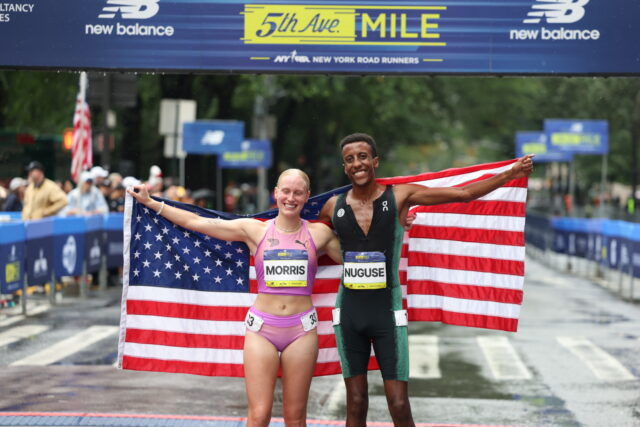
NEW YORK (07-Sep) — Disappointed to have missed a spot on Team USATF for the upcoming World Athletics Championships in Tokyo, Yared Nuguse found a different way to end his season on a high note, winning a thrilling New Balance Fifth Avenue Mile road race in Manhattan. Gracie Morris was the surprise winner of the women’s division, using a well-timed kick to secure victory. The races were held in light rain, capping a day of mass participation, age-group and specialty heats featuring more than 8,500 participants at the New York Road Runners-organized event.
MORRIS NAILS HER TIMING
The women’s elite race went off first, and defending champion Karissa Schweizer, who ran 4:14.8 to equal the event record last year, immediately went to the front down the 20-block straight-line, downhill course. A two-time Olympian in the 5000 and 10,000 meters, she knew she would need to rely on her strength up against a field of established middle-distance runners. She admitted that her enthusiasm, combined with the course’s initial downhill slope, may have caused her to push the pace a bit too hard. Leading Morris by 10 meters, Schweizer earned the race’s $1,000 halfway leader bonus.
Morris, fifth in this event last year, continued to track Schweizer while remaining several steps ahead of a pack that included Dani Jones, Gabbbi Jennings, Eleanor Fulton and Kayley DeLay. Shortly after the three-quarter mile mark Morris began to close the gap on Schweizer, who still looked strong but was beginning to strain. With about 300 meters to go Morris decisively surged into the lead. She remained unchallenged to the finish and won comfortably in 4:15.5.
“I knew I needed to stay patient and that I could get her,” said Morris, who joined the Puma Elite Running Team in North Carolina a year ago after graduating from Texas Christian University. “And right around 1200 I knew that’s a key point in this race, so I just started pressing.”
Morris finished 9th in the 1500 meters at the USATF Outdoor Championships in early August and then won the Sir Walter Miler (track mile) a week later, smashing her track personal best with a 4:23.74 clocking. “This is one the best seasons I have had, just confidence wise and having consistency. I don’t feel like I’ve had a bad race,” she said. “I really wanted to win this one and use this momentum to go into next year.”
Behind her, Kayley DeLay broke free from the pack and tracked down Schweizer, edging ahead for second place just before the finish, 4:17.4 to 4:17.6. Fulton (4:18.9) and Laurie Barton (4:20.6) rounded out the top five.
“I’m happy with this,” said Schweizer, who finished a disappointing sixth in both the 5000 and 10,000 at the U.S. championships. “It’s been a weird year. I feel like this race and my 5K in Brussels [where she clocked a season’s best 14:39.30] showed that I’m not as far off as I thought.”
NUGUSE'S PRIDE HELPED CARRY HIM TO THE WIN
The men’s race played out quite differently, with a huge pack running together in the early going. No significant moves were made until Flavien Szot bolted to the front just in time to earn the halfway leader bonus. (He would eventually finish 12th.)
The pack quickly caught the Frenchman. Nuguse --who opened his season in New York City in February with his third straight victory in the Wanamaker Mile at the Millrose Games-- was at the center of the road, with his expected chief rivals, Josh Hoey and Hobbs Kessler, to his right, while Luke Houser and Amon Kemboi were on his left. Hoey, the runner-up here in 2024 and this year’s world indoor champion in the 800 meters, nudged briefly ahead, but could not gain any separation.
With a quarter mile to go, Parker Wolfe swung wide on the right and edged into the lead, appearing poised for an upset. But a cluster of men remained on his heels and just steps before the line Nuguse found one more gear and broke the tape in 3:47.7, becoming the first American man to win this race since Eric Jenkins in 2016.
“I feel like a lot this year I haven’t really had the kick I wanted, and I think with that downhill energy and also this being my very last race, I really just wanted to leave it all out there,” said Nuguse, the Olympic bronze medalist in the 1500 last summer in Paris. “When Parker passed me that just ignited something within in to really leave it all out there.”
Wolfe (3:48.1) held off Drew Hunter (3:48.1) for second, followed by Ireland’s Nick Griggs (3:48.4) and Kenyan Festus Lagat (3:48.4). Kessler (3:49.6) came home 10th and Hoey (3:51.9) finished 13th.
The win gave Nuguse a nice boost after his season took a shocking turn at the U.S. championships, where he was relegated to fifth place in the 1500. The On Athletics Club star’s bid to earn a wild card into the World Championships by winning the Diamond League Final in Zurich on August 28 fizzled out when he finished seventh, leaving him off of the national team for Tokyo. “After what happened in Zurich I was a little bummed that that was the end of my season, but Fifth Avenue only asked me [to run here] after that race,” he said. “I liked the idea of racing a fun race. I wanted to win, but I wanted to have an enjoyable [experience] and I heard that Fifth Avenue has really fun vibes.”
Wolfe also found redemption with his performance. An injury cut short his senior season at the University of North Carolina this spring, but he rallied to place 6th in the 5000 at the USATF Championships on minimal training. “I thought I had it until the last 10 meters,” he said of his bold move today. “I started tying up a little bit. I’m very happy to feel that gear be there. It’s been a while since I’ve really had that. I felt like myself racing again, so that was awesome.”
Morris and Nuguse both recorded the third fastest times in event history and pocketed $5,000 in prize money for their victories.
PHOTO: Gracie Morris and Yared Nuguse celebrating their 2025 New Balance Fifth Avenue Mile victories (photo by John Nepolitan for Race Results Weekly)
American 20K Record & National Title For Mantz at Faxon Law New Haven Road Race
(c) 2025 Race Results Weekly, all rights reserved. Published with permission.
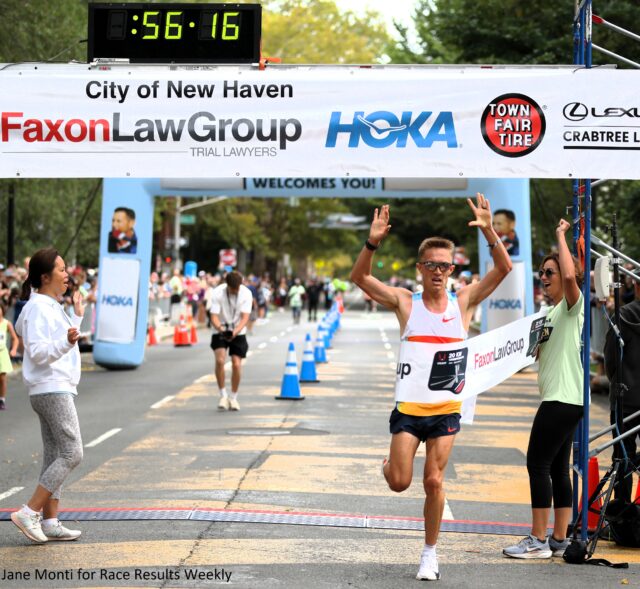
NEW HAVEN (01-Sep) -- On a cool and cloudy morning here, reigning USA Olympic Trials Marathon champion Conner Mantz showed that his training for October's Bank of America Chicago Marathon is right on track, breaking his own national 20K record at the Faxon Law New Haven Road Race by seven seconds. Mantz, 28, went through 10K in 27:50, then came back in the hilly second half of the race in 28:26 to run 56:16. His mark set a new USATF 20K Championships record and also broke Khalid Khannouchi's 27 year-old event record of 57:37.
"I think this was the exact type of race I needed in preparation for Chicago," Mantz told a small group of reporters after the race. "A win always is helpful, but the biggest thing was a really hard effort. You can push in workouts, and push a lot. But today, this was really, really tough."
Mantz, who won here in 2022 and finished second in 2023, also had to fight a pitched battle for the win today against Isai Rodriguez and Hillary Bor. The trio were part of a six-man lead pack which zipped through the first mile in 4:23, and the second in 4:33. They were joined by Shadrack Kipchirchir, Casey Clinger and Zouhair Talbi. Clinger and Kipchirchir fell back in the fourth mile, and Talbi had to let go in the fifth mile when the first three split 22:25.
"They were moving so quick," Mantz said of Rodriguez and Bor. "At halfway I think we were at 27:50, or something like that. It was quick. At that point I was like... if I run about 4:45 pace the rest of the way I'll get the course record. But these guys didn't slow down. They kept pushing."
Bor, the race's defending champion, tried to use his energy wisely. He was content to let Rodriguez and Mantz switch-off at the front.
"If there is someone there to push the pace, then I'll just sit at the back," Bor told Race Results Weekly. "When Rodriguez took the pace, I said 'this is perfect.'"
Rodriguez, the 2023 Pan Am Games 10,000m champion, did most of the leading. In what was his first race of the year, he wanted to keep the pace high and give himself a chance at the podium. He led through 10 miles in 45:31 --a time which was only 16 seconds slower than the American record-- and stayed with Mantz and Bor until the final push to the finish line along Temple Street in Downtown New Haven. It was there that Mantz and Bor started to pull away.
"Conner and Hillary started pushing," Rodriguez recounted. "I was just trying to stay relaxed a bit. I guess I wasn't there quite yet."
Rodriguez fell back and finished third in 56:34, a time which is equivalent to a 59:54 half-marathon according to the time-tested Riegel Formula. Bor was right on Mantz's heels, but only for a few strides. Mantz hit the gas, dropped Bor, and ran to the finish line alone. Bor finished second in a huge personal best of 56:32, despite slowing a bit in the final meters to acknowledge the cheers of the crowd. Talbi held on to fourth place, running most of the race alone, in 57:39, and Clinger was fifth in 58:05.
"I pushed and pushed and I looked back and Hillary was gone," said Mantz of the final kilometer. "I knew at that point I could win. I told myself just keep that sub-4:20 (per mile pace). I got the American record, which was a surprise."
Galen Rupp, who like Mantz is training for the Chicago Marathon, finished 19th in 1:00:22.
The women's race saw a first-time winner who, like Mantz, is coached by Ed Eyestone of Brigham Young University. Aubrey Frentheway, who finished second at Grandma's Marathon in Duluth back in June in 2:27:14, broke away from her rivals in the middle of the tenth mile and went on to win in 1:05:36. It was her first national title.
"Honestly, it's like my first big pro win and I'm kind of emotional," Frentheway told Race Results Weekly. "It was good. Before the race I had no idea how I'd feel. I've been dealing with a hamstring issue for, like, two months. I was kind of nervous and I felt like at mile-nine for some reason I felt good, so I'm going to go."
Biruktayit Degefa, a three-time Chevron Houston Marathon champion, took second in her first race as an American citizen. The Ethiopian-born runner threw up immediately after finishing, but after a moment to collect herself she was clearly pleased with her time of 1:05:42. She said that she was injured most of the last two years.
"The race was tough, very tough," Degefa said. "But after, finally, second place I am happy."
Ednah Kurgat, the 2023 USATF Cross Country Championships winner, took third in 1:05:46 followed by 2:27 marathoner Maggie Montoya (1:05:57). Reigning USATF Cross Country champion Carrie Ellwood finished fifth in (1:06:08).
Both Mantz and Frentheway won $9000 in prize money, and Mantz picked up an additional $1000 for setting an event record. Overall, the race paid out a $38,000 prize money purse.
The Faxon Law New Haven 20K is part of the USATF Running Circuit. Only one event remains on the circuit for this year, the national marathon championships to be hosted by the California International Marathon in Sacramento, Calif., on December 7. The overall circuit champions will receive $15,000 in addition to the prize money they earned at individual races.
PHOTO: Conner Mantz winning the men's division of the 2025 Faxon Law New Haven Road Race in an American record 56:16 (photo by Jane Monti for Race Results Weekly)
Sisson To Make Long-Awaited NYC Marathon Debut
(c) 2025 Race Results Weekly, all rights reserved. Published with permission.
NEW YORK (19-Aug) - She's had to wait five years, but USA marathon record holder Emily Sisson will finally get her chance to run the TCS New York City Marathon this November. Sisson, 33, a two-time Olympian who has won eight national titles, was supposed to run what would have been the 50th edition of the world's largest marathon in 2020, but the race was cancelled due to the pandemic. She had to settle for running the race "virtually" on the Silver Strand Bikeway in Coronado, Calif., accompanied by her husband, Shane Quinn, on a bicycle (she ran 2:38:32).
"Enjoyed pushing myself and looking forward to the next opportunities," Sisson wrote on her Instagram at the time. "Here's to making the best out of 2020!"
Sisson is part of a strong elite field for the 2025 race, which will take place on Sunday, November 2. The competition will also feature marathon debuts by track Olympians Joe Klecker and Hillary Bor of the USA, previous women's champions Sharon Lokedi and Hellen Obiri of Kenya, and title defenses by Sheila Chepkirui of Kenya and Abdi Nageeye of the Netherlands. But for Sisson, the race should be particularly special given that she is both America's fastest-ever marathon woman and that her kit sponsor, New Balance, has a deep and long-running relationship with both the TCS New York City Marathon and the race founders and organizers, New York Road Runners.
"I am so excited to be lining up in New York!" Sisson told Race Results Weekly in an e-mail. "New York City really is my favorite place to race because the energy is always incredible. NYRR also does an amazing job, always, and I can't wait to be back in November."
Sisson's road running career actually began in earnest eight years ago in New York. On a near-freezing day in March of 2017, Sisson and then-training partner Molly Huddle ran the United Airlines NYC Half. The pair, who had come from a warm-weather training camp in Arizona, ran together the entire way and Huddle just edged Sisson by two seconds, 1:08:19 to 1:08:21. Sisson's time was a USA half-marathon debut record. She began to see that the marathon would be her future.
"It's pretty special," Sisson told Race Results Weekly that day. "I didn't even know what [the record] was coming into today, but I'm pretty happy, especially to do it here, a tough course."
Sisson wouldn't step up to the marathon until April of 2019 when she ran the TCS London Marathon. She was very fit coming into the race, running a 1:07:30 half-marathon in Houston in January and then a world-leading and personal best 30:49.57 for 10,000m at Stanford University at the end of March. On paper, the London race went great (Sisson set a USA debut and national record of 2:23:08), but she had actually fallen during her warm-up and banged her knee on the pavement. That injury would later lead her to withdraw from the 2021 edition of the TCS New York City Marathon.
"A few weeks before Tokyo (Olympics), my knee started to hurt pretty badly," Sisson said through Instagram in October, 2021. She continued: "I took a week off after Tokyo (where she ran the 10,000m, placing tenth) hoping to heal. Not for a lack of trying, I haven't really been able to train for 2.5 months now. So after a great year of training and racing, I'm prioritizing health and giving my body the rest it needs! New York Road Runners, I will be back racing soon."
The following year, Sisson would choose Chicago for her fall marathon instead of New York. In May, 2022 she set a national record for the half-marathon of 1:07:11 (since broken), then crushed it in Chicago with a second place finish and North American record of 2:18:29. Sticking with the race plan coach Ray Treacy had given her, Sisson split halfway in 1:09:26 then came back in a slightly faster 1:09:03. The three previous North American record holders --Keira D'Amato, Deena Kastor, and Joan Samuelson-- were on hand to see her finish.
"It's amazing," Sisson said in her post-race broadcast interview. "The women standing here today, they've all accomplished so much. To be amongst them is an incredible honor."
Although Sisson lowered her national half-marathon record to 1:06:52 in January, 2023, that did not translate into a faster time at Chicago later that year (2:22:09). She had struggled to overcome a side stitch in the final third of the race.
"I felt actually pretty good until mile 18 in the race," said Sisson. "I was proud to gut it out the last 8 miles."
As a practical matter, Sisson couldn't run New York in 2023 because the race was too close in the calendar to the 2024 USA Olympic Team Trials Marathon in early February of 2024 (running Chicago gave her adequate recovery time). That turned out to be a good move as Sisson had a great day at the Trials, finishing second in 2:22:42 and securing her Paris Olympic Marathon starting spot (she would finish 22nd in 2:29:53 on a hot day). There would be no fall marathon for her in 2024, typical for an athlete who runs a summer marathon at a major championships.
Sisson's life has changed a lot since 2020. Her husband, who is Irish, is an Irish Association for Counselling and Psychotherapy accredited mental health counselor and therapist, and has set up a practice in Tramore, County Waterford. Sisson has been spending a lot of time in Ireland this year and has jumped into a few local races to help her stay sharp (she ran a road PB of 14:58 for 5-K at the Streets of Kilkenny 5K, for instance). She skipped the Toyota USATF Outdoor Track & Field Championships this summer in Eugene, and plans to run the AJ Bell Great North Run half-marathon on September 7 in England as part of her build-up.
"I feel really motivated for this one as I have had my eyes on it for so long," Sisson said of the NYC Marathon. "Now I finally get to race it!"
The full elite field is at this link, along with the official press release: https://www.nyrr.org/media-center/press-release/2025_0819_tcsnycmproathletefield
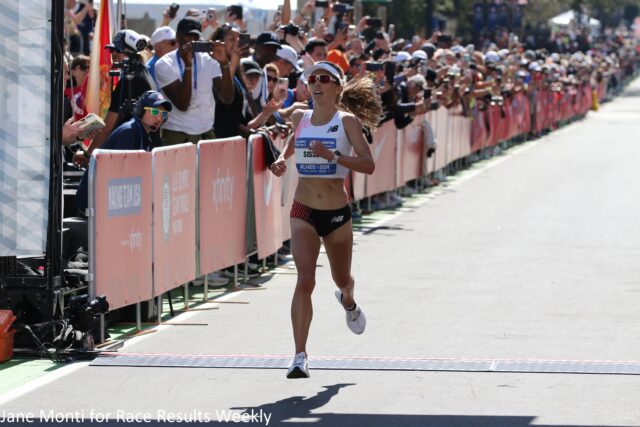
PHOTO: Emily Sisson finishing second at the 2024 USA Olympic Team Trials Marathon in Orlando, Florida, on February 3 (photo by Jane Monti for Race Results Weekly)