5 Questions with Olympic Gold Medalist Dawn Harper-Nelson
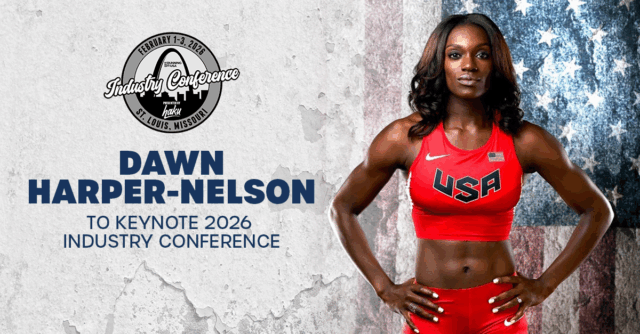
Two-time Olympic medalist and East St. Louis native Dawn Harper-Nelson will serve as the keynote speaker at the 2026 Running USA Industry Conference presented by haku, taking place in St. Louis, Missouri, Feb. 1-3, 2026. Get to know her ahead of the event in this new interview!
Harper-Nelson’s inspiring remarks will open the event at the Union Station Hotel on Monday, Feb. 2. Register here.
Harper-Nelson’s athletic journey began at East St. Louis High School, where she clinched six state titles in hurdles events. She continued her athletic and academic pursuits at UCLA, earning multiple All-American honors and leading the Bruins to a national championship. In recognition of her achievements, Harper-Nelson was inducted into both the UCLA Athletics Hall of Fame and the St. Louis Sports Hall of Fame.
Beyond the track, Harper-Nelson is a dedicated community ambassador and volunteer in the St. Louis area where she lives with husband and two children. She has served as an ambassador for the United Way of Greater St. Louis and the American Diabetes Association, using her platform to inspire and educate area youth.
How to Attract Elite Athletes to Your Event
Something that makes running unique from nearly any other sport is that your neighborhood weekend warrior can — and often does — compete in the same races as world-class athletes. Spend a few hours at the finish line of any major marathon, and you’ll likely see Olympians, former college athletes, and beginner runners alike.
Having high-performing athletes at your event can help raise its prestige and grow its popularity. Often, catering to elite, sub-elite, and locally competitive runners is mutually beneficial for these athletes and the reputation of your event.
Here are some things you should consider when planning to host elite athletes and tips for attracting them to your race.
Consider your budget and race size
Not every race is equipped to host the reigning Olympic or World champions, and that’s okay. For the best-of-the-best runners, running is typically their full-time career. These professional athletes, in part, rely on prize money earned from racing to pay their bills and support their families. That’s one reason why you most often see pro runners participating in major races like the Chicago, New York City and Boston Marathons, which offer six- and five-digit prize purses along with hefty appearance fees and highly competitive fields.
Still, this doesn’t mean you can’t attract plenty of talented runners to your event. Most up-and-coming elites, sub-elites, and competitive amateurs have day jobs and don’t expect to earn a substantial check from racing. Instead, they value other perks like discounted race fees, exclusive and convenient accommodations, travel and lodging allowances, and the proper competition and conditions to run a personal best.
Determine your elite time qualification standards
Before considering how you’ll attract elite athletes, you need to determine who qualifies as “elite” at your race. There is no universal time standard for an elite race field; instead your event organizers get to determine it. Additionally, some race organizers update their standards annually — or even throughout the year as race day gets closer and the elite field begins filling up.
Most often, time standards are based on the size, historical competitiveness, and prestige of your race. For example, a recent performance of 3:00:00 for a woman and 2:40:00 for a man may qualify for an “elite” entry at a relatively small, local or regional marathon. Meanwhile, many of the nation’s largest marathons require a time of at least 2:45:00 for women and 2:25:00 for men.
If you’re unsure where to set your time standard, review the websites of a few similarly sized races, or talk with fellow race directors through Running USA. It could be smart to set a similar standard to races comparable to yours. Additionally, keep in mind that a runner’s qualifying time should reflect their current abilities. It is common to require athletes to have run your event’s time standard within two years of your event in order to be considered for the elite field.
Some races offer a two- or three-tiered system, with each tier having stricter time standards and more perks as you move up. For example, the 2025 Indianapolis Monumental Marathon offers elite, seeded elite, and sub-seeded elite categories:
Indianapolis Monumental Marathon elite athlete and pace team coordinator Matt Ebersole said having three athlete tiers enhances the race’s depth and energy. Plus, it empowers young and developing athletes. He said he doesn’t want the elite race to be so much faster than the general one that they “essentially become two separate races.”
“I love standing at the finish line, and, after the first runner comes by, they just keep coming,” Ebersole said. When it comes to developmental athletes, including those hoping to qualify for the Olympic Trials, he said, “We can give them a taste of that elite treatment. It’s great for up-and-coming runners to come into an elite area and see people they know or maybe follow on social media. After the race, that inspires them to train harder and do what they need to do to get to that level.”
As you can see in the Indy example, while the time standard is often based on the same race distance as your event, it doesn’t have to be. If you plan to offer equivalent time standards (such as permitting a half marathon or 10K time to qualify an athlete for an elite marathon field), it could be helpful to use free online tools like the McMillan Running Calculator to determine equivalent performances.
Here’s how Indy’s elite “perks” increase with each tier:
Having different levels of perks allows Indy to provide more runners with the elite treatment while being cognizant of physical space and financial resources. “We want to make sure (the elites) are having a great experience while not taking away from the experience of anyone else,” Ebersole said.
Should you ever make exceptions to your time standard?
Ebersole shared that while he doesn't make many exceptions to Indy’s posted time standard, he thoroughly looks at every application to see where and when each athlete ran their qualifying time.
“If someone’s close and they ran it on a downhill course, then it’s a no,” he said. “If they ran close on a hot day at the Boston Marathon, then yes … or if someone was pregnant last year and doesn't have a recent performance but they have a strong history of racing well over the last several years. So, it depends on the situation.”
Encouraging elites to register for your event
Word spreads quickly in the running community. Elite participants will likely tell their friends, training partners, and teammates if your race was well organized, competitive, and fun.
But, if your race is new or returning after a long hiatus, it’s crucial to promote it and connect with athletes online and in-person if you want competitive runners at your start line.
Here are some helpful tips:
● Have a designated elite athlete coordinator on your team who can advise the team on decisions regarding the elite field, answer questions from elite athletes and their coaches, and go through applications for the elite field.
● Connect with high school varsity, collegiate, sub-elite, and elite teams in your city, state, or region. Offer discounted or free entries to anyone on the team interested in signing up for your event. With high school and college teams, be aware that athletes may be unable to participate in your event during their fall and spring competition seasons.
● Contact your local running clubs and running specialty stores. See if they can help connect you with nearby runners who meet your time standards or can suggest athletes for you to contact.
● Don’t be afraid to reach out if you know of an elite athlete of any level who has a personal, geographic, or other connection to your event (perhaps your race benefits a cause they’re passionate about). Some runners, including top performers, may surprise you with their willingness to participate. Even if a runner can’t compete in your event, they may be interested in making an expo or finish-line appearance.
● With the athletes’ permission, feature elite participants on social media ahead of your event. Ask the athletes to share on video or in writing what inspired them to sign up for your event, how they are preparing, and what they hope to achieve. Share these posts on your event’s social media accounts and encourage featured athletes to repost them. If a runner’s training partners, teammates, and competitors see that they’re excited about your event, they’re more likely to check it out themselves and possibly register. As mentioned, high-level runners are attracted to opportunities to push themselves in a competitive field. If an elite runner knows that many athletes of their caliber have enthusiastically signed up for a race, they won’t want to miss out!
A note on agents: When working with the highest level of elite runners (think Olympic and/or professional), you’ll likely communicate with the athlete’s agent rather than the runner themselves. Top athletes pay their agents to negotiate entry into races, including appearance fees. Agents also assist with travel and lodging arrangements.
What perks are elite runners looking for?
Below are some common perks that are attractive to (and sometimes expected by) elite runners. If you plan to offer any of these at your race, be sure to publicize them on your event website and social media so athletes are aware prior to registration.
1. Free or discounted race entries: Many races offer free or discounted registration fees to athletes who meet certain time standards. Sometimes, this is the same standard required for entry into the elite field. Other times, an even faster qualifying time is required for a free entry while “slower” elites receive a discount. Like time standards, you can implement multiple discount tiers.
2. Lodging and travel stipends: Some races, especially larger ones, offer travel stipends and/or lodging for elite athletes. This is less common at smaller races. Again, you should consider the size and budget of your event. See the travel and lodging perks offered at the 2025 Grandma’s Marathon:
3. Elite bottle stations: Any good race will have water, electrolytes, and possibly other aid stations along the route. However, many high-level athletes prefer a special hydration or nutrition blend unique to their needs, especially in longer-distance races like a marathon. If you’re hosting elite marathoners, highly consider providing elite bottle stations — exclusive tables throughout the race where elites can easily grab their special, in-race nutrition. Be sure to arrange a way for athletes to provide your staff/volunteers with their bottles ahead of time.
4. Special pre-race waiting area: Help ease race morning stress by offering an elites-only, pre-race waiting area near the start line of your event. Athletes will probably be most grateful to have elites-only bathrooms and skip the porta-potty line! Also consider providing water and space for runners to stretch and warm-up before the race.
5. Prize money and record bonuses: Even if you can’t offer thousands of dollars to the athletes who make your event’s podium, consider awarding small prizes to the top three or five finishers in the elite field. Many races also offer additional monetary bonuses for breaking the event’s course record. Make sure to publish the current record and bonus prize amount ahead of time to encourage athletes to go for it!
World Record Holder Ruth Chepngetich Provisionally Suspended
(c) 2025 Race Results Weekly, all rights reserved. Published with permission.
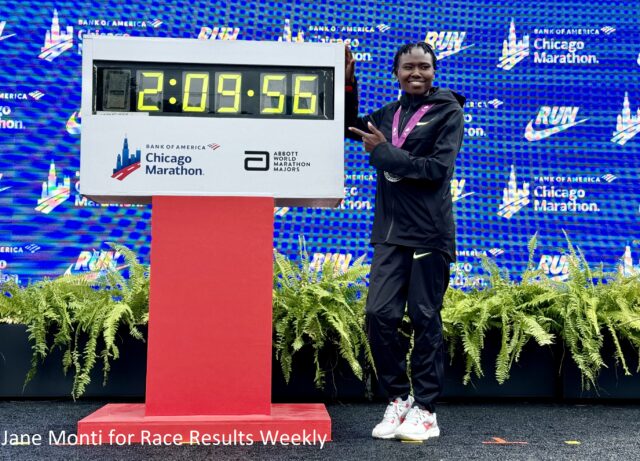
(17-Jul) -- Ruth Chepngetich, the 2019 World Athletics Championships marathon gold medalist who ran a world record 2:09:56 at the Bank of America Chicago Marathon last October, has been provisionally suspended by the Athletics Integrity Unit (AIU) for a doping infraction. The 30 year-old Kenyan tested positive for Hydrochlorothiazide (HCTZ), a diuretic, in a urine sample collected from her on March 14 of this year.
Under AIU procedures, the athlete was issued a Notice of Charge after an investigation was launched. Chepngetich was interviewed by AIU investigators in Nairobi on April 16 and "complied with requests regarding our investigation," according to AIU chief Brett Clothier.
"When there is a positive test for diuretics and masking agents, a provisional suspension is not mandatory under the World Anti-Doping Code," Clothier explained through a press release. "Chepngetich was not provisionally suspended by the AIU at the time of notification. However, on 19 April, she opted for a voluntary provisional suspension while the AIU's investigation was ongoing." Clothier continued: "In the intervening months, the AIU continued its investigation and today issued a Notice of Charge and imposed its own provisional suspension."
The AIU said that they would have no further comment on the case until it reached its conclusion. A diuretic does not increase performance per se, but can mask the presence of other drugs. Hydrochlorothiazide, and other diuretics, are "banned at all times," according to the World Anti-Doping Agency.
An HCTZ reading of 20 nanograms per milliliter in urine would be considered a negative result, but Chepngetich tested at a far higher level: 3800 ng/mL.
Although Chepngetich's world record in Chicago was ratified by World Athletics, the mark was looked upon with doubt by at least some experts. She slashed the previous world record by a hefty one minute and 57 seconds, and would have finished 11th in the men's race. She ran the first half in 1:04:16, and her halfway split was the fastest-ever half-marathon run in the United States by a woman.
Former Runners' World editor and 1968 Boston Marathon champion Amby Burfoot was openly skeptical of Chepngetich's performance. Writing for marathonhandbook.com, Burfoot wrote: "Chepngetich's performance is only about 7.75% slower than Kelvin Kiptum's men's marathon world record. It should be 10 to 11% slower, like all the other male-female differentials in the running record books. There's a massive amount of data behind these percentages, and historically any small variation amounts to a highly suspect performance."
During the post-race press conference in Chicago, Robert Johnson of Letsrun.com asked Chepngetich how her then-pending record should be viewed given the dozens of doping violations recorded by the AIU for Kenyan athletes in recent years. Johnson said: "What would you say to someone that, when they see 2:09:56, say this is too good to be true?" Chepngetich hesitated before saying she didn't know. Johnson was criticized by Kenyan officials, including some in the Kenyan National Assembly, who saw his question as insulting.
Seven Kenyan athletes received doping sanctions in June, and there are currently 139 Kenyan athletes serving doping bans, the most of any country.
Chepngetich has only competed once since her Chicago run. She took second at the Lisbon Half-Marathon on March 9. She was supposed to compete in the TCS London Marathon on April 27, but withdrew prior to the race.
"I'm not in the right place mentally or physically to race my best in London and I am therefore withdrawing," Chepngetich said through a statement provided by London Marathon Events. "I am very sad to miss the race and I hope to be back next year."
PHOTO: Ruth Chepngetich after setting her marathon world record at the Bank of America Chicago Marathon on October 13, 2024 (photo by Jane Monti for Race Results Weekly)
Chebet, Kipyegon Dazzle With World Records At Prefontaine Classic
(c) 2025 Race Results Weekly, all rights reserved. Published with permission.
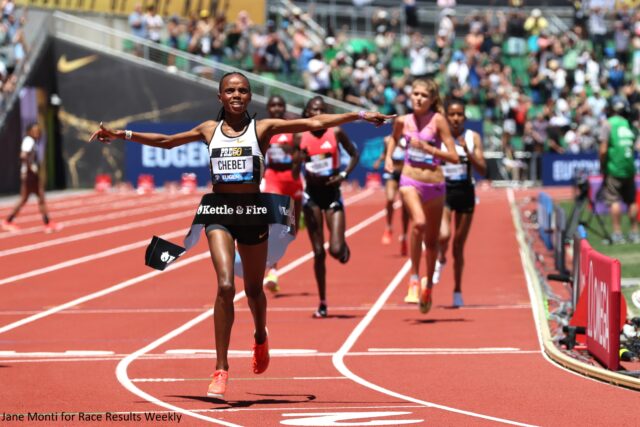
EUGENE (05-Jul) -- The gala 50th edition of the Prefontaine Classic lived up to all the hype, punctuated by world record performances by Kenyans Beatrice Chebet and Faith Kipyegon. Chebet, 25, became the first woman in history to break 14 minutes for 5000m, clocking 13:58.06 in a race which also served as the Kenyan Trial for the 2025 World Athletics Championships in Tokyo in September. Kipyegon, 31, rebounded strongly from her attempt to break four minutes for the mile in Paris just over a week ago and ran 3:48.68 for 1500m, the first ever sub-3:49 by a woman. Nearly all of the 12,650 seats at Hayward Field at the University of Oregon were filled for today's meeting, the ninth stop of the 2025 Wanda Diamond League.
Chebet got her record first. In warm, sunny and slightly breezy conditions, the reigning Olympic 5000m and 10,000m champion followed pacemakers Klaudia Kazimierska of Poland and Dorcus Ewoi of Kenya through the first kilometer in 2:47.07, then the second in 5:35.37. After the pacers dropped out, Chebet took the lead and kept up the high tempo. Only Ethiopia's Gudaf Tsegay, the previous 5000m world record holder, and Kenya's Agnes Jebet Ngetich could hold such a blistering pace. Chebet split 3000m in 8:22.96 setting a new stadium record for that distance.
"I can say I pushed a lot after the pacemaker dropped," the tiny Chebet told reporters. "I pushed for myself and I say, I have to go because I am the one who wants a world record for myself and go for it."
Neither Tsegay nor Ngetich wanted to lead, so Chebet had to do all of the work. For the two laps before the bell (measured from the finish line), she split 66.9 then 68.4. In the final lap she still had her two rivals very close with just 200 meters to go, but she exploded around the final turn leaving them in her wake. She ran her final lap in 61.9 seconds.
"I'm so happy," Chebet told reporters. "Today I can say it's a great day for me. Achieving sub-14:00 in women, being the first woman sub-14:00 is amazing for me."
Ngetich passed Tsegay to take second, 14:01.29 to 14:04.41. Another Kenyan, Margaret Akidor, was a distant fourth in 14:30.34. Chebet now holds the world records for both 5000m and 10,000m (28:54.14). She's the first woman to accomplish that feat since Ingrid Kristiansen of Norway in 1986.
Kipyegon's record was, perhaps, more expected. She ran a sub-4:07 mile in the Nike-sponsored Breaking4 exhibition race in Paris, and was clearly fit coming into today. Meeting organizers moved the women's 1500m to be the final event on the program, bumping the usual curtain-closer, the Bowerman Mile for men, to an earlier time slot. When Kipyegon was introduced, the crowd gave her a huge cheer.
"I almost cried because everybody was waiting for me," Kipyegon said. "You know, I was the last one on the track, the last event of the day, and it's just so amazing everybody was waiting for you to test the world record, everybody cheering you. I felt at home."
Sage Hurta-Klecker of the On Athletics Club was the designated pacemaker, and after cutting in to the rail first she quickly stretched out the field. Hurta-Klecker hit the 400m mark in 61.61 seconds with Kipyegon, Australia's Jessica Hull (the 2024 Olympic silver medalist) and Ethiopia's Diribe Welteji close behind. Hurta-Klecker passed 800m in 2:03.17, then peeled off at the end of the backstretch. Kipyegon still had Hull with her, but not for long. After 1200m (3:04.68) the three-time Olympic gold medalist moved up a gear and started to open a significant gap on Hull. Kipyegon kept pushing and, as the crowd roared, she broke the tape.
"First, I want to thank God," Kipyegon said, when asked about how she felt. "This was really special. As I said in Paris that I was still capable of running under 3:49, and I surprised myself today doing that." She continued: "It's something special."
With about 100 meters to go, Welteji caught, and passed, Hull to take second in a personal best 3:51.44. Hull ran a season's best 3:52.67 in third, and Olympic bronze medalist Georgia Hunter Bell finished fourth in 3:54.76.
In the men's 10,000m --which served as the official World Athletics Championships Trial for Kenya and an unofficial trial for Ethiopia-- 18 year-old Biniam Mehary got the win in a world-leading 26:43.82, the second-fastest time of his career. Mehary, along with compatriots Berihu Aregawi and Selemon Barega, broke away from the main pack early in the race behind the pacemaking of Benjamin Balazs and Kasey Knevelbaard, both Americans. Joining the group was a lone Kenyan, Benson Kiplangat, who saw running with the Ethiopians as his best chance take a top-three finish among the Kenyans
"For me I needed to be top three for Kenya qualification, so I was not needing a record," Kiplangat told Race Results Weekly. "I needed to run with the Ethiopians to survive in the group."
Knevelbaard went through 3000m in a fast 7:51.77 before dropping out. That left the four Africans to manage the pace and keep the rest of the field at bay. About 15 seconds behind another Kenyan, Edwin Kurgat, kept his cool and his eyes forward. He was confident that if he stayed with his race plan he could close the gap.
"I've been running 10-K for a little bit longer now," he said. "I know what it takes, and I knew what I had to do today to make that team."
With Mehary and Kiplangat trading places at the front, the foursome went through 5000m in 13:14.17, on pace to break 26:30. Neither Aregawi nor Barega would lead, but that didn't bother the good-natured Mehary.
"The plan was go get a pretty fast time," Mehary told reporters through a translator.
At 8000m (21:28.71) it looked like only Mehary, Kiplangat, Barega or Aregawi could finish on the podium. But their pace got just a little slower, and at 9000m (24:13.16) Kurgat had caught up. That set up a thrilling final sprint from about 150 meters out. Kiplangat led on the bend, but soon drifted back and would have to settle for sixth place in 26:50.00, a personal best.
"For me, I don't have a sprinting, I don't have a kick," Kiplangat lamented.
But Mehary did. He passed Aregawi on the inside with just a few meters left in the race to get the win. As he was sprinting, he wasn't confident that he had the power to beat his older and more accomplished rival.
"I was definitely not sure because I know these guys," Mehary admitted. "They're very strong athletes, and they have good finishing speed. I wasn't sure but, obviously, I'm very happy with the results."
Aregawi was timed in 26:43.84 and Barega in 26:44.13. Kurgat took fourth in 26:45.35, and as the top Kenyan in the race he secured his position in the World Athletics Championships.
"I just executed my race," Kurgat told Race Results Weekly. "I had to stay really tactical, and strong and have something left for the finish."
American marathoner Conner Mantz fought off a side stitch and finished 12th in 27:35.72.
"I just set intermediate goals every lap just to speed up a bit," he told reporters of the second half of his race. "It's hard to be in a race like this. I was expecting to run 64's, but they went out way faster than that."
In the other distance events there were quick times and exciting finishes, especially in the Bowerman Mile where Dutchman Niels Laros executed a spectacular come-from-behind race, just pipping USA mile record holder Yared Nuguse at the line by 1/100th of second. Laros's time of 3:45.94 was a Dutch record and made him the third-fastest European of all-time.
"The legs felt good, and I could just kick," Laros told reporters. "It was amazing."
For 95% of the race Laros wasn't a factor. He ran with the main pack while Nuguse and Frenchman Azeddine Habz followed the pacemaker Abe Alvarado at the front. By the halfway point, Nuguse had a small gap on Habz and was trying to run away with the race.
"I really wanted to go out there and give it everything I had, straight up, to the line," Nuguse said. "I definitely died a bit."
Nuguse came into the homestretch with a lead of several meters on Habz, and Laros was back with the pack. But in the final 50 meters, the 2024 Olympic bronze medalist started to tie up. Habz was also tiring and couldn't catch the American, but Laros sliced down lane one past Habz and towards Nuguse. He caught Nuguse right at the line, shooting a look to his right just as he caught him.
"I was just in the pack and I couldn't really do anything about them running away," said Laros. "But once I came to the front I didn't immediately think about closing that gap. I just wanted to go fight for the podium. I was feeling better than expected and I came closer and closer."
Cole Hocker, the former Oregon Duck who won the Olympic 1500m title last August, took fourth in a personal best 3:47.43. Back in ninth place, double Olympic bronze medalist in the 5000m and 10,000m Grant Fisher finally toppled his ten-year old mile personal best of 3:59.38 set in high school, clocking a very grown-up 3:48.28.
"It feels good to have a new mark," said Fisher with a laugh.
The International Mile --easily the word's best "B" section for a one-mile race-- was won by Ethan Strand who just wrapped up his NCAA career at the University of North Carolina. Wearing his new Nike pro kit for the first time, Strand dominated his race to win in 3:48.86.
"That feels good," Strand told reporters. He continued: "That's the beauty of the International Mile to go compete for the win today. That always builds confidence. If I had been in the Bowerman Mile it would have been more like, see how long you can hang on and see how fast you can run."
In the two other distance races on the program, the women's 800m and 3000m steeplechase, the winners were Tsige Duguma of Ethiopia in 1:57.10 and Winfred Yavi of Bahrain in a meeting record and world-leading 8:45.25. The 800m race marked the return of 2021 Olympic 800m gold medalist Athing Mu-Nikolayev who had not run her two-lap specialty in competition in nearly a year. She had a tough day, finishing tenth and last in 2:03.44.
"It definitely sucks not being able to have run a couple of 800's before this," Mu-Nikolayev told the assembled media. "You know, working out at practice is really great, but when it comes to competition it takes a little bit more. We knew that coming in."
PHOTO: Beatrice Chebet of Kenya setting a new world record in the 1500m at the 2025 Prefontaine Classic (Photo by Jane Monti for Race Results Weekly
Mu-Nikolayev To Run Her First 800m In Nearly A Year At Prefontaine Classic
(c) 2025 Race Results Weekly, all rights reserved. Published with permission.
EUGENE (04-Jul) -- When she takes to the track to run the Mutola 800m at the 50th Prefontaine Classic at Hayward Field here on Saturday, it will have been 351 days since Athing Mu-Nikolayev will have competed at the distance where she won the Olympic gold medal in Tokyo in 2021 and set the American record of 1:54.97 in 2023. Under coach Bobby Kersee the 23 year-old athlete has been returning to competition slowly, focusing on over-distance races including a 5000m (where she dropped out as planned at 3000m), and two 1500's where she ran modest times of 4:21.18 and 4:10.70, respectively. It's all part of Coach Kersee's plan to have the former high school star from Trenton, N.J., healthy and in peak shape for the World Athletics Championships in Tokyo in September.
"On the track side of things I think people have learned to understand that he knows what he's doing," Mu-Nikolayev said of Kersee at a press conference here yesterday. "And though he may take different approaches that other coaches may not take, whether it's more risky and not of the norm, in the end his plan works out the best for his athletes, and he does not steer us the wrong way. Just growing in trust together has been a big thing over the past couple of years."
Mu-Nikolayev, who trains with four-time Olympic gold medalist Sydney McLaughlin-Levrone, is trying to bounce back from a disappointing year. At last summer's USA Olympic Team Trials, also held here in Eugene, Mu-Nikolayev tripped and fell in the 800m final just 200 meters into the race. She regained her feet, finished in last place, and did not qualify for the Paris Olympics. She ran only one other race before shutting down her season, and she did not return to competition until April 18, 2025, where she ran the first 3000 meters of the 5000m at the Mt. SAC Relays in Walnut, California.
"It's more fun to do it out here than in practice, just in terms of getting some longer runs in," Mu-Nikolayev said in her post-race interview when asked why she had competed at Mt. SAC. "It was definitely long, longer than 800m, longer than 1500m."
While the two 1500's reacquainted her with faster running, those races were nothing like what she will face on Saturday when she will square-off against 2023 world champion Mary Moraa of Kenya, 2024 world indoor champion Tsige Duguma of Ethiopia, 2021 Olympic bronze medalist Raevyn Rogers of the United States, and 2025 world indoor champion Prudence Sekgodiso of South Africa, among others. The world-leading time of 1:56.64, set by Duguma in China in May, is likely to come under threat.
"I think this is falling at the perfect time for preparation for the USA's and, obviously, world championships in September," Mu-Nikolayev said of Saturday's race. She continued: "It's really great to be able to run a fast, competitive 800 around this time of the year."
All of Mu-Nikolayev's competitors have already been racing hard this season, which would seem to leave her at a disadvantage. That's not how Mu-Nikolayev sees it.
"You have to trust your coach if you want to improve and get better with them," Mu-Nikolayev explained. "So, that's just a super-important thing that I hold with Bobby and Bobby holds with me. So, I trust that year to year, if we have to adjust things, do things different, that in the end he'll have me ready for what's most important, championships, whether the Olympics or worlds."
Saturday's race is named after Maria Mutola, the legendary runner from Mozambique who won the Olympic 800m title in 2000 and was the world 800m champion in 1993, 2001 and 2003. Mutola, now 52, won the 800m at the Prefontaine Classic a dozen times from 1992 to 2008. Mu-Nikolayev has won it twice, in 2021 and 2023, setting meet records both times. She definitely enjoys running at Hayward Field, although she appeared to be slightly nervous about doing a "rust-buster" in such hyper-competitive circumstances.
"I'm super-excited, actually, to be back here at the Pre Classic," Mu-Nicolayev told reporters. She continued: "I'm just excited to go out and just see where my body is at this point of the year in the 800. I'm excited to run fast; I know it's not going to be a slow race."
When asked whether she had a time goal, Mu-Nicolayev said she wanted to break two minutes. She added: "I think just going out there and feeling good, both mentally and physically, is the most important thing for me. And seeing the results, obviously, no matter what the time may be, is always a plus. But, I think just completing that race, doing two full laps, would be a really great thing."
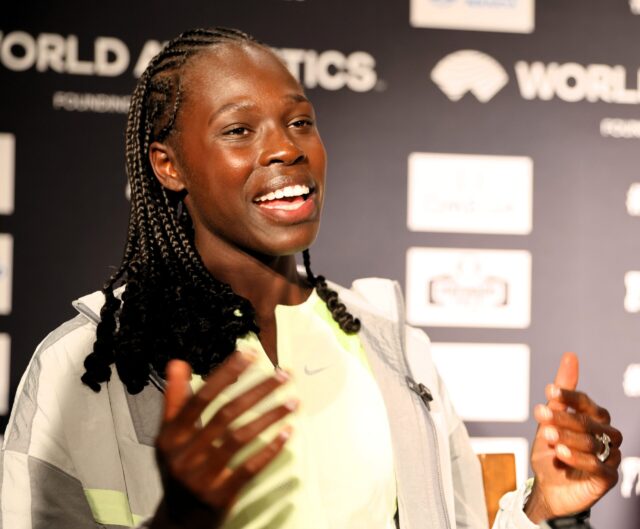
PHOTO: Athing Mu-Nikolayev speaking with reporters at the 50th Prefontaine Classic press conference in Eugene, Oregon (By Jane Monti for Race Results Weekly)