
Key Takeaways from Running USA's Race Participation Growth Webinar
Following the release of a new Running USA industry insights report that shows significant growth for many running events in the first half of 2024, the organization held a webinar with four race production professionals to learn first-hand what they have experienced at their events.
The report (free to download for all active Running USA members) shows significant growth in race participation across various race distances. The growth ranges from 12.5% to 26%, with marathon finishers up by 26%. Individual races and race weekends (comprising multiple race distances) saw substantial increases, particularly 5Ks (19%), 10Ks (20%), half marathons (15.5%), and marathons (26%). These numbers are derived from finisher data through Athlinks, excluding no-shows.
Moderated by Running USA Executive Director Jay Holder, the participating panelists were:
● Dan Lakin, Sr. Event Operations Manager and Race Director, Ventures Endurance (Louisville Triple Crown of Running)
● Becky Radliff, Director of Marketing and Events, Eugene Marathon
● Ashlee Snider, Director of Marketing, Metropolitan Richmond Sports Backers (Ukrop’s Monument Avenue 10K)
● Mike Wattigny, Marketing & Creative Director, FRESHJUNKIE Racing (Louisiana Marathon)
Read on for more insights from the virtual session and watch the recording in its entirety here.
Meet the featured events
The Eugene Marathon experienced a 31% growth in participation across its half marathon and marathon distances (2023-2024). Becky Radliff attributes this to strong community engagement and successful virtual races during COVID.
The Louisville Triple Crown of Running reported a 28% total growth, with their 5K and 10K races seeing 31% increases and the 15K achieving a 25% increase.
The Louisiana Marathon saw a 28% growth in finishers. Mike Wattigny noted that industry-wide inertia, combined with the closure of other races, contributed to their leadership position in the region.
The Ukrop's Monument Avenue 10K in Richmond had 23% growth, with finishers increasing from 15,200 in 2023 to 18,732 in 2024. Ashlee Snider explained their focus on community and celebration to maintain engagement post-pandemic.
Post-pandemic return to racing and runner re-engagement
All of the speakers discussed the challenges and strategies of restoring participation after the pandemic. Becky Radliff (Eugene Marathon) mentioned their focus on a virtual race experience in 2021, which helped retain runners. Ashlee Sneder (Ukrop’s 10K) emphasized the importance of community and celebration to re-engage participants after a three-year hiatus.
Mike Wattigny highlighted several strategies FRESHJUNKIE has employed to connect with their audience post-pandemic. One key tactic was the launch of an ambassador program, which gained traction in response to decreasing returns from digital marketing efforts. By putting out a call to their runner database, they received over 100 applicants, resulting in a selection of "micro-influencers" who actively participated in local running clubs and events. The success of this program encouraged them to expand the ambassador team for the upcoming season, further enhancing community engagement.
Wattigny discussed compensating ambassadors with race entries, gear, and VIP access, tailoring incentives to encourage long-term commitment and participation. He acknowledged that while the ambassador program has yielded positive results, there is a learning curve in guiding influencers to maximize their social media impact. He plans to strengthen their communication and coaching efforts to drive even greater returns from their ambassadors in the future.
Dan Lakin talked about the importance of rebuilding trust within the running community after the challenges of the pandemic. His team took a hands-on approach, meeting with running clubs, reading past event surveys, and engaging with their community to better understand and cater to their needs. They also developed VIP programs and experiential enhancements, such as food and music, to elevate the participant experience and ensure future growth.
Curating a memorable event that generates a fear of missing out
Becky Radliff echoed similar sentiments on participant experience, stressing the importance of focusing on every interaction—from social media engagement to race day execution. Her team invested heavily in documenting race weekend through video and photography to boost organic reach, especially on Instagram Reels. She attributed much of the race's recent growth to these visuals and their consistent engagement on social media.
Wattigny agreed, saying that video, particularly vertical video on platforms like TikTok, plays a crucial role in showcasing the event's experience, helping to expand their reach beyond local participants.
Demographic trends reflected in participation increases
Snider (Ukrop’s Monument Avenue 10K): Demographics are skewing younger, with growth in the 18-29 age range (+4 percentage points from 2022 to 2024). Racial diversity is increasing as well, with rises in Black (+2%) and Hispanic participants, while White participants decreased (-3.5%).
Lakin (speaking about Chicago events): Similar trends, with growth in younger, more diverse groups due to partnerships with community groups like Black Girls Run and Latinas Run.
Wattigny: Marathon events seeing a slight increase in younger participants. The growth of female runners (60-65% in half marathons) and the importance of grassroots connections are emphasized.
Both Lakin and Snider noted that marketing efforts for shorter races like 5Ks and 10Ks tend to be more localized, targeting nearby runners and drive markets, while longer races, like half-marathons and marathons, tend to attract participants from farther afield. Snider mentioned that the Richmond 10K has benefited from outreach to local run clubs and attending expos in nearby cities, boosting awareness without heavy investment in paid advertising.
Marketing and budgeting strategies
Lakin: 8-10% of revenue goes toward marketing, with a $4-5 acquisition cost per participant for shorter distances.
Wattigny: Higher acquisition costs (~$10) for marathons, shifting back to grassroots tactics and reducing reliance on digital marketing due to changes in algorithms.
Forecasting growth was challenging. Radliff and Lakin discussed making real-time adjustments to procurement based on race growth, such as medals and participant caps.
Post-race and spectator experience
Snider: Ukrop’s Monument Avenue 10K is branded as Richmond's biggest block party, focusing on engaging spectators and volunteers to create a festive atmosphere.
Radliff: Post-race experiences for participants at Hayward Field are enhanced by opening the stadium for participants to relax, enjoy hot pancakes, beer, and watch the race.
Paid VIP post-race experiences were common across all events, offering exclusive access to food, drinks, and comfortable seating.
**
Looking for more insights? Watch the full recording and stay tuned for the release of the 2024 Global Runner Survey from Running USA.
Participant Equity at the HAP Crim Festival of Races
Staff and participants of the iconic race in Flint, Michigan share their personal stories in our four video, article series
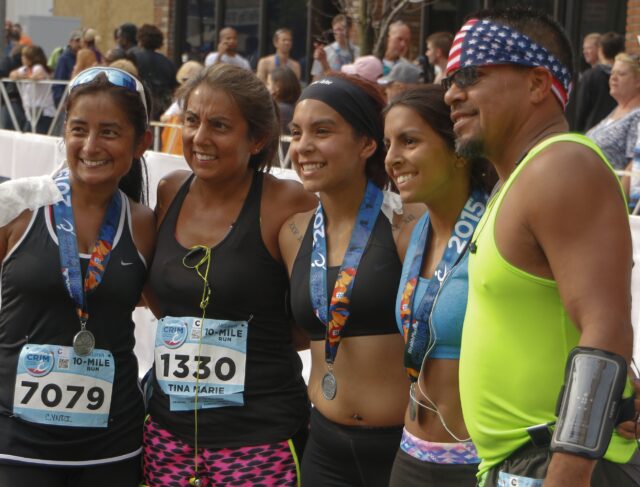
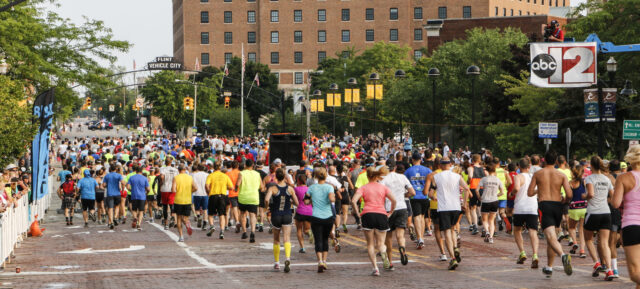
FLINT, MICHIGAN - After 46 years of its existence, the HAP Crim Festival of Races weekend has not only become a local holiday in Flint, Michigan, but it is a celebration of Flint’s perseverance. “The Crim,” as it’s known, is one of the biggest events of the summer in Flint, Michigan. Ten thousand runners, walkers, wheelchair racers and other athletes come out for the 10-mile, 5 mile, 5K, one mile and kids’ races during this weekend in late August.
Flint, Michigan is known internationally for its contaminated water crisis. They’ve had a boil filtered water advisory that started in 2014 and was not lifted until February of this year.
One of the positive side effects of the water crisis was new health and wellness programs - initiatives that had not been a focus in Flint previously. The Crim was an obvious partner. In addition to producing the August race weekend, The HAP Crim Fitness Foundation works year-round to provide programs for adults, seniors and children that include access to nutrition, mindfulness training and exercise.
“It's been nine years since the water crisis began, and there’s still that fear,” said Liz Jones, HAP Crim Associate Director of Races and Training.
As an example, she recently had a sixth grader in one of her programs ask her what would happen to him if he were to take 20 showers.
“I was confused by that at first. Then I realized the problem: he's scared about being in the water and what damage the water could do to him. That's still a very relevant fear for a lot of people here in Flint,” Jones explained. “This is an already underserved population and now they are recovering from a pandemic on top of the lingering water crisis issues.” (Watch Liz Jones' video.)
“Overcoming barriers to participation has been a focus of the Crim staff for some time, but it has become a heightened priority in the last few years,” says Lauren Holaly-Zembo, HAP Crim Fitness Foundation CEO.
“As a race, we're telling people to run or walk or be active, but we know if they don't have the place or the means to do that, they're not going to. So we have to really look at addressing all of that in what we do,” Holaly-Zembo said.
(Watch a video with Lauren Holaly-Zembo.)
“The reality that the founding of this race that was based on inclusion and it started to raise money for Special Olympics and athletes with special needs. And we've continued to do that throughout our history,” Holaly-Zembo said.
The Crim was founded by longtime Michigan politician Bobby D. Crim, who served in the Michigan House of Representatives in the 1970’s and 80’s. He ran his last 10-mile race, his 45th straight, at the 2021 event.
"The community is the Crim, the Crim is the community," Crim said in a 2016 interview. "Almost everything from education to fitness ..goes through the Crim. We were a race, but now we're much more than a race.” Today, that vision has expanded to include runners and walkers who may never have been able to participate in the past.
Running USA recently had the chance to speak with several runners who have been trailblazers in the Crim’s inclusivity efforts. Here are their stories.
Father Time: A wrestler and a walker
Father Time is his wrestling name. Yes, you heard that right. His birth certificate, however, says Leo Napier. Due to his vision impairment, he does not have a driver’s license, but that doesn’t hold him back from much else.
“The Father Time character has inspired a lot of people. When I was 60, that's when I started professional wrestling, I'll be 71 years old this year.” Napier told us.
The story of Father Time’s wrestling career is documented in a powerful long form story from BELT Magazine by writer Scott Atkinson. An especially moving paragraph is this one:
“He’d spent his whole life trying to wrestle, but things continually got in the way. Things like cancer in his digestive system when he was still in his twenties and was trying to make contacts with wrestling organizations. About ten years later he tried again but was rear-ended while driving and hurt his back and neck. He was a father then, and life was simply busier. Around age 50, he started thinking about it again, and he had a stroke. And then another. And a third. He’d been a power lifter his entire life and was still bench-pressing more than 350 pounds at the time, but after each stroke he felt weaker and weaker. After his third stroke he heard the doctor say to his wife, ‘I can see that he was once a strong man.’”
Father Time recalls his daughter running the Crim a few years ago, and feeling like it was “a little bit of a strange thing to do.” Stranger than beginning a pro wrestling career at 60? Probably not.
Now vice president of the Flint/Genesee chapter of the National Federation of the Blind, he was recruited by his friend Sheila Fulmore to join the walking team this year.
“We look at it as we can overcome any obstacle that's put in our way. All we have to do is just have the fortitude and the grit to do it. When (sighted people) see that we can do this, too, it changes a lot of minds and a lot of hearts,” Napier said.
(Watch the video to hear more of Father Time’s story.)
Access for Deaf Runners and Walkers
Kid Black Fedio is a Deaf advocate, lifelong teacher of American Sign Language and for the past six years, a run/walk group leader for the Crim. She was looking for a winter activity to keep active and ended up expanding the deaf community’s access to Flint’s largest running event.
“We ended up having more than 30 participants our very first year. This summer, we already have more than we had last year. It's a huge thing. People love it. I love it. It's great to all be included,” she said.
Feedback she received from last year’s Deaf participants was this:
“They felt that they were not brushed aside. They told me that if you provide the access for us, we will show up.”
The most important part of true accessibility, Fedio explained, is authentic inclusion. It’s also vital to for events to consider expanding their signage pre-event, on course and post-event, so that those with hearing loss are able to successfully navigate the course and venue. If possible, consider bringing in an ASL interpreter for any main stage announcements or speeches made at the event.
For training inclusivity, Fedio recommends being proactive in bringing on group leaders who can relate to the runners and walkers.
“If you let a Deaf person lead, it is going to be more successful. I would try to recruit a Deaf adult that is familiar with this, or a pair, a Deaf adult and a hearing person, and have them lead the group. And then it will fly.”
(Watch the video to hear more of Kid Fedio’s story.)
There’s No Stopping Sheila Fulmore
Sheila Fulmore is the President of the Flint/Genesee chapter of the National Federation of the Blind (NAFB). When she first participated in the Crim 5K last year, she surprised even herself.
“When we got to the middle, I was like, ‘Oh, I can't do this.’ And I just wanted to stop.” She’d been told to just put one foot in front of the other until she reached the finish, but her body was tired.
Encouragement from a stranger on the course helped.
“This gentleman came up behind me and said, we are almost there. Let’s go. I just wanted to him to get me a ride to the finish line. But he walked with me a bit and got me going. It was going through my head that I really don’t give up.” So she didn’t.
“I finished it. And that inspired me to go, you know what, they have a training program, we should get in that program.”
She is now a leader of the Crim’s visually impaired runner/walker group, with 12 members of the NAFB chapter participating this August and the hope that many more will join. Her advice to this year’s first-time participants?
“Just remember that you want to finish. Don’t get hung up on your time. I don't want that to be a factor. I want you to have fun. I want you to socialize, I want you to get out and I want you to just walk.”
(Watch the video to hear more of Sheila’s story.)
The 46th HAP Crim Festival of Races will take place Friday and Saturday, August 25 and 26. Learn more at https://crim.org/.
**
Share your event stories with us: Running USA encourages event and vendor members to share their stories of success with us. Email Leah Etling, director of marketing and communications, to learn more.
Expanding Green Options: Event Merch and Sustainability
A few years ago, when Tash Acres was training for a half-marathon, she looked at the cheap medals and t-shirts from past races, saw how they piled up, and thought there had to be a better way. Her family was trying to eliminate waste in their lives and focus on their role in the environment, but she couldn’t find an event that didn’t add to the pile of stuff. Many avid runners have had a similar thought, staring at their stack of race memorabilia sitting in a corner or box.
Acres’ original project was to plant trees for every virtual race athletes ran, but “people still want something tangible,” she said.
And that’s how the concept of a plant-able medal was born.
At first, she just created the biodegradable medals for her own virtual challenges, but today Earth Runs delivers biodegradable medals with seeds embedded in them to other small races in the UK and Ireland, each one hand-made from partners at nonprofit organizations.
“I like medals. I’ve had medals in my time, but then I don’t know what to do with them after,” she said.
It’s a growing sentiment. With runners spending so much of their time outside, there’s an increasing concern about the impact that time is having on the outdoors. One study found that a marathon runner, on average, emits .7 tons of CO2 equivalent—with that number going past 4 tons if it involves a trans-oceanic flight to the race.
While there are entire fields of study devoted to creating sustainable best practices for events, the merchandise, trash, and stuff you hand out is one of the most visible pieces to runners—and one of the most frequently asked about.
A longtime industry vendor perspective
Leslie Jordan, Inc., a Certified Women’s Business Enterprise out of Portland, Oregon, is among the apparel manufacturers that have made efforts to diversify their products and offer green packing and shipping options.
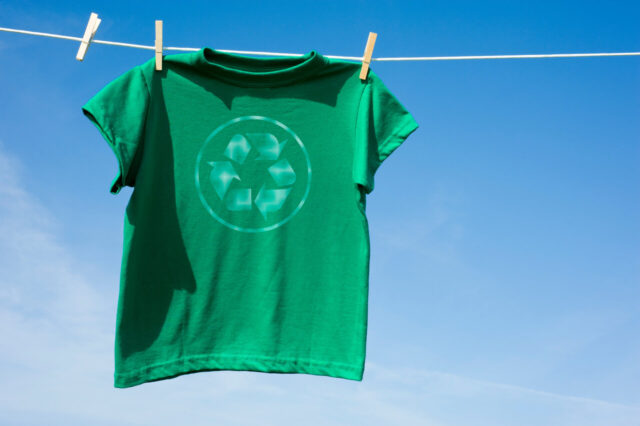
“We offer all our moisture wicking polyester fabrics in a recycled option. Even our blend shirts (triblend, poly/rayon, poly/cotton) can be made with recycled poly material,’ shares Jena Bakkum, sales lead for LJI. “Our shipping boxes are made from recycled materials, with help from the ‘Sourcing for Sustainable Forestry Initiative.’ We discourage all poly bagging of apparel and use bulk folding. For fulfillment we use recycled shredded paper as filler instead of bubble wrap and recycled mailers whenever possible”
LJI has found that the most popular items in demand from participants are recycled shirts. But they come at a cost.
“Recycled options are more expensive so races may need to increase registration costs to balance the need and request for recycled shirts,” said Bakkum.
On the flip side of that equation, races may consider letting athletes opt out of certain swag items, rather than paying more.
“he trend we are seeing is making shirts and medals optional ‘for purchase,’ so there is little to no waste in manufacturing and landfill,” Bakkum noted.
Sustainable principles and tips for your next race
When it comes to considering the environmental impact of your race, the Council for Responsible Sport’s guide to hosting responsible events recommends going through your race and asking: Do we need this thing? Can we have less of this thing? Does it generate trash? Is there a more sustainable option? And how can we integrate sustainability into every aspect—for example, building compost plans into aid stations and eliminating trash in the expo, or making it part of vendor contract agreements?
When it comes to sustainability practices, said Aly Criscuolo, sustainability and corporate social responsibility director for the New York Road Runners, there are both behind-the-scenes things like switching to electric generators instead of gas, which can have a large impact but be unknown, and also highly visible things, like eliminating medals or moving to recycled medals, which can give runners a way to buy-in to the overall effort.
“We have to do both,” she said.
1. Reduce and reuse
“No matter how sustainable you make a produce, it’s not as sustainable as not buying something new,” said Criscuolo.
That’s why best practice s first to figure out how you can reduce overall materials. Anything that can be reused is ideal: Don’t put dates on signage or on t-shirts so they can be used in the future. Reusable water bottles, bib magnets instead of pins (if you can reuse them year after year) all helps.
Big caveat: If you invest in reusable cups or signage and then just throw it out the next year, that doesn’t do much good.
Many big races have also worked through their trash lifecycle to eliminate waste. For example, the Chicago Marathon tested separating plastic water bottles out for recycling, using compostable cups that could be gathered up after the race, and working with a company that could make composite board products from the foil heats sheets given to runners at the finish line.
The Council for Responsible Sport also recommends working with local vendors and vendors who already build sustainable practices into their business—partially because if you work with a local vendor who can print additional t-shirts, for example, on demand then you’re less likely to have extras wasted, and partially because local vendors eliminate the need for shipping and transport.
2. Give athletes options
You can also give athletes a simple box to check in the registration flow. They can opt out of a medal or t-shirt for a slight discount on their race entry—which could also save you money. Or you can partner with a nonprofit organization to allow them to donate the amount instead. NYRR partners with Mastercard to plant trees for those who opt out of the t-shirt or medal for their Mini 10K and have planted over 800 trees, said Criscuolo.
While there are ways to get creative encouraging carpooling and opting for virtual goodie bags, another simple popular option is allowing athletes to buy carbon offsets. The Cherry Blossom 10K in DC used to ask runners to donate the amount of a subway ride if they chose to drive instead of take the train, but then switched to a simple option for any runner to donate $5 to purchase carbon offsets and saw a large increase when they gave athletes that simple choice.
There are some things in race management that are avoidable, said Criscuolo, but traveling to the race isn’t. By definition, you want athletes to come to your race. This is where carbon offsets or donations can be useful.
3. Do your research
If you’re going to use carbon offsets, then verify that the company is certified, for example by Gold Standard, said Criscuolo. If you’re going to have a company plant trees, then make sure the organization will maintain those plantings, not just stick a tree in the ground and leave, she said.
There are many recycled and sustainable material merchandising options, such as sustainable fibers for t-shirts and wood or recycled metals for medals. NYRR uses recycled steel now, and many trail races have success with wood. But the best practice is using as much upcycling as possible—which means taking something that would be trash and putting it to a higher use. For example, some bike races will use old bike parts to make medals or integrate a cup into their medal. Or, you can use programs like Earth Runs or Trees Not Tees. Do the research for what makes sense for your event.
All of this can be a little confusing, of course, which is why Criscuolo recommends reaching out to organizations and experts, like the Council for Responsible Sport or the Green Sport Alliance. They’re often happy to help or think through your plans. One of the most common mistakes she sees race directors or event organizers make is to do something quick that they hope is more sustainable, but it actually isn’t, like trying to compost stuff that isn’t compostable or not knowing if recycling is really the best option in their local trash system. “There are lots of resources and people who want to help,” she said. Use them.
4. Communicate with your runners
Many race directors are worried that if they eliminate medals or t-shirts, athletes will think they’re being cheap and not sign up. The key, said Criscuolo, is communicating. If you’re going to opt for wood or recycled medals, or run cup-free aid stations, then make sure you’re clear with your runners about why you’re doing it.
“Runners still want quality,” said Criscuolo, but if the quality is there and they know why you’re making the change, then studies show they will pick the more sustainable option.